
YouGov and the Impact of COVID on Cash

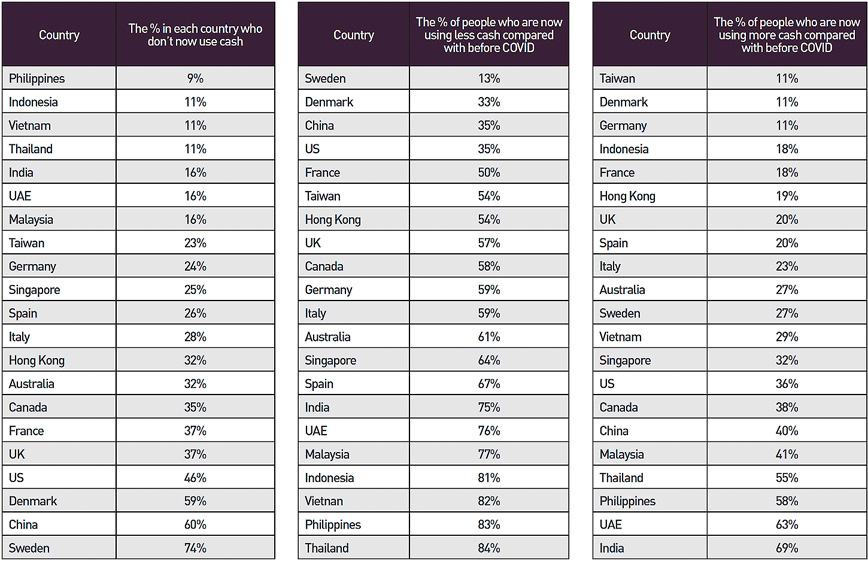
YouGov have carried out a survey in 21 countries asking about payments in the pandemic, which provides an interesting snapshot on the relative impact of COVID-19 on cash usage around the world.
Unsurprisingly there has been a widespread decline in people saying they had used cash less often, although 16% said their usage had increased, but the detail in the survey may indicate how vulnerable cash is to a ‘shock’ reduction in usage once we have learned to live with COVID-19.
11 countries surveyed were in Asia, a region that has already started to use less cash and with established alternatives available. The UAE was the only Middle Eastern country in the survey, a heavy cash user but with good cashless infrastructure. Seven countries were in Europe, which, along with Canada, already have the infrastructure in place to move to less cash. Amongst those European countries, Germany, France and Spain were heavy cash users before the pandemic. The US is an outlier in terms of being advanced but not having the infrastructure in place before the pandemic for contactless payments.
Given this mix of countries, the countries that might tell us the most about the future of cash are the likes of Vietnam, Thailand, Malaysia, Indonesia, the Philippines and Taiwan. These countries are still relatively early in their move to less cash, while a country like Sweden used little cash even before the pandemic. 74% of Swedes said they rarely used cash before the pandemic and so the change to less cash was commensurately small, at 11% the smallest decrease in the countries survey.
Low cash users pre-COVID and how that changed
Although only a snapshot caught in a survey, the data throws up some interesting indicators. As expected, Denmark, Sweden and China were low cash users before the pandemic. The data also suggests the US, Germany, Italy and Spain were low cash users as well. This goes against the accepted wisdom and does skew the overall pandemic figures, placing them as countries with relatively low cash use.
The biggest increase in the percentage of countries now using less cash, compared with the total that didn’t before the pandemic and now don’t use cash, was largely in Asia.
The change in the US is relatively low, but this perhaps reflects its lack of less-cash infrastructure. The move to less cash in Canada, France, Taiwan and Hong Kong also looks relatively low compared with other neighbouring countries, while perhaps, Spain, Italy and Germany are more than one might have expected.
High cash users pre-COVID and how that changed
Much of the impact of COVID might have been expected given what was happening pre-COVID. Looking at this data, the change in Asia is particularly large, but perhaps Canada, the US and Singapore are also greater than one might have expected. Equally, Germany and France are relatively low.
Do people like the idea of less cash?
The number of people who either didn’t know or didn’t think less cash was either good or bad, was high. The range was 11%-35% with five countries between 11% and 20%, 13 countries in the 20%-30% bracket and three 30% or more.
Over 30% of the population regarded less cash as a negative in every European country, the US, Canada and Australia. In contrast, no Asian country reached 30% regarding less cash as negative.
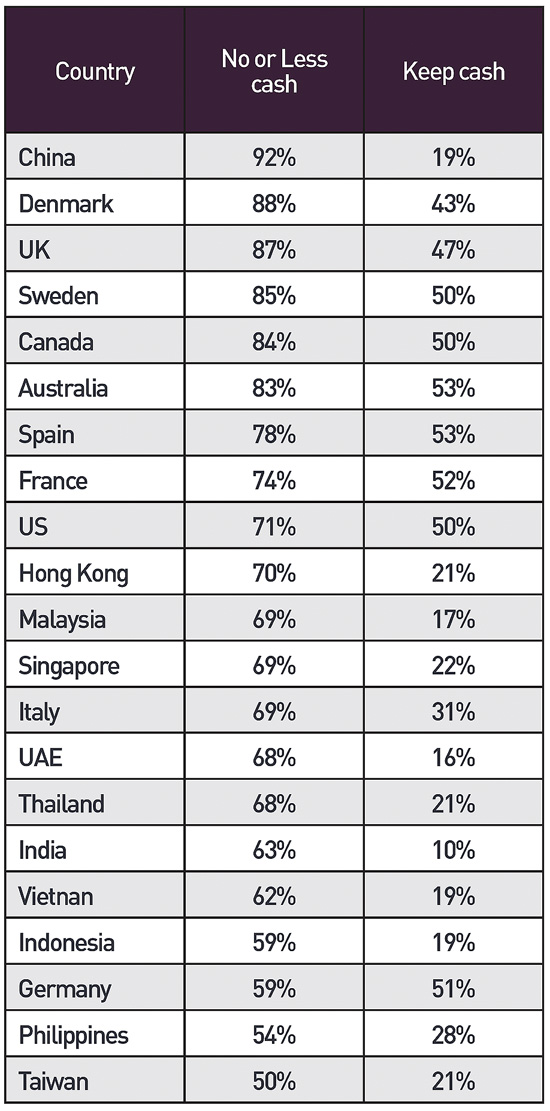
Of the 10 countries using less or no cash now, all except China and Hong Kong score less cash as a negative with a score of over 40%. It is ironic that the biggest movers to less cash are the countries who regard less cash with scepticism or worse.
Possible conclusions
Although a YouGov survey with all the known limitations it brings, this data does highlight the possible impact of COVID. Asia has clearly changed, but the impact on some European countries is not consistent with their historic record of cash usage. The survey places the starting positions of some countries differently, but the end positions are equally unexpected. The change in the US perhaps reflects its unusual payments story.
The public’s attitude towards whether cash, or less cash, is a negative or positive suggests that many don’t have a view, or at least a firm view. Whether it is the optimism of Asia or that many European/ North Americans are already starting to experience the reality of less cash, the divide in attitude to cash between them is stark. It has not stopped people changing their behaviour to use less cash.
This perhaps indicates the problem. People say one thing, but do another.
(This article also appeared in the November issue of sister publication Currency News™).
Subscriber content
Read the full article
Full access to Cash & Payment News articles, newsletters and archives.