
Payment News

Challenges of Financial Inclusion
A recent article in Kenya’s Star newspaper looked at why the informal transport system of ‘matatus’ (privately owned cars or minibuses acting as shared taxis) does not make use of M-Pesa wholeheartedly. It suggests two reasons.
First, it is possible to reverse a transaction if money has been sent incorrectly. The sender has to call customer care and give the details of the transaction. Many matatu operators are wary of being defrauded by people using this facility.
Second, M-Pesa offers its users a continuous overdraft facility known as Fuzila up to an agreed limit. It is a product of CBA Bank offered by Safaricom as part of its M-Pesa payment system. When users deposit money into their M-Pesa account, Safaricom reduces the overdraft plus a small facility fee or interest charge. The article says millions of Kenyans have significant debts from Fuliza and don’t want to receive money into their M-Pesa accounts where it is swallowed up repaying those debts, leaving them unable to withdraw cash.
Perhaps including people into the financial system using electronic payments is more complicated in practice than in theory.
Diem Moves Operations to the US
The Diem Association, which is overseeing the development of a digital currency, is moving its operations from Switzerland to the US. It has been working to get a payments licence from the Swiss regulator but will now partner with Silvergate, a US bank. Silvergate will be the exclusive issuer of the Diem US Dollar stablecoin.
Diem Networks US will now register as a money service business with the US Department of the Treasury’s Financial Crimes Enforcement Network so that it can conduct a pilot for person-to-person transactions.
The ‘Pain of Paying’
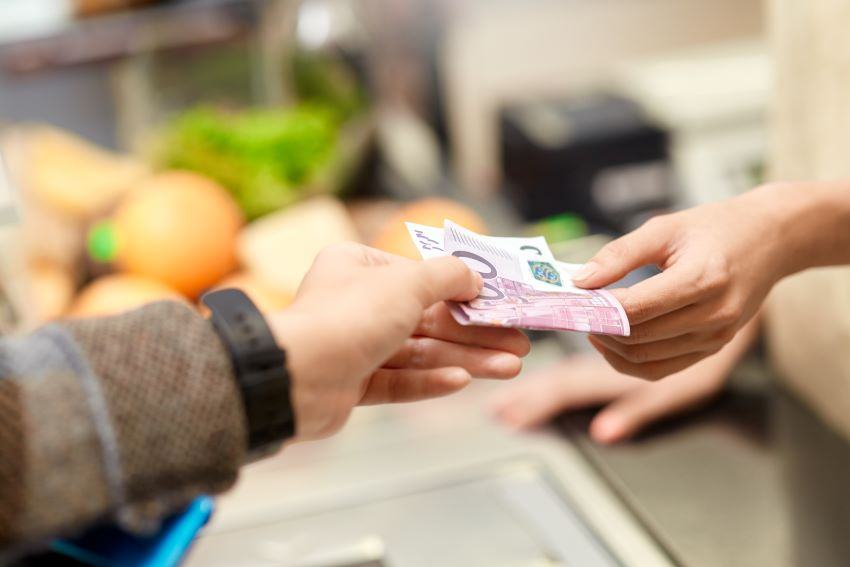
An article in the Journal of the Association for Consumer Research explains how cashless payments can increase consumers' spending on unhealthy food . Apparently, the body responds differently to cashless payments and this changes how consumers behave.
The authors propose that there is such a thing as the ‘pain of paying’. When you pay by card or mobile wallet, the payment occurs at a later date. Such transactions are not concrete, it says, and cashless payments are less likely to elicit the negative arousal that is appraised as the 'pain of paying’.
Pain is known to highlight risk, and the lower level of negative arousal experienced when paying cashless means consumers are less aware of the risks associated with deciding to spend money. This research was looking at food purchases and so it suggested that less pain means people paid less attention to choosing to buy unhealthy food. The authors coined the phrase ‘decision risk inattention’.
The authors conducted a lab experiment where they measured changes in physical arousal levels. When people thought about paying cashless there was lower arousal than when thinking about paying with cash. When participants were paying in cash, they were less likely to add unhealthy items, and visa versa. The payment method had no impact on decisions to buy healthy food items.
In a similar study people were told a company wanted to understand the popularity of several different desserts and they were asked how much they would pay. Participants who thought they were paying cashless were willing to pay more than those paying in cash.
Perhaps shops going cashless have read the research.
Alleged Wrongdoing in the UK’s Pre-Paid Card Market
Mastercard, allpay and PFS have admitted that they took part in alleged anti-competitive arrangements when they agreed not to compete or poach each other’s clients relating to pre-paid cards used by local authorities to distribute welfare payments.
The provisional findings of the UK’s Payment Systems Regulator (PSR) found that they, and two other companies, APS and Sulion, had broken the law. The PSR said there were two infringements of competition law; between 2012 and 2018 all five companies were involved, and between 2014 and 2016 APS and FPS.
It is reported that if the PSR’s final conclusion is that there have been infringements, then the three have agreed to pay maximum fines totalling over £32 million.
MoneyGram Work to Bring Bitcoin to the High Street
MoneyGram is working with cryptocurrency cash exchange Coinme to enable the cash funding and payout of digital currency purchases and sales.
Combining MoneyGram's mobile and API-driven payments platform with and Coinme’s proprietary cryptocurrency exchange and custody technology, the partnership promises to bring bitcoin to thousands of new point-of-sale locations in the US, it says.
In the coming weeks, select MoneyGram locations in the US will let users purchase Bitcoin with cash and withdraw their holdings of the cryptocurrency in cash. International locations will follow.
‘This innovative partnership opens our business to an entirely new customer segment as we are the first to pioneer a crypto-to-cash model by building a bridge with Coinme to connect Bitcoin to local fiat currency,’ said Alex Holmes, CEO, MoneyGram.
Tesla Backtracks on Bitcoin
Electric car manufacturer Tesla has suspended vehicle purchases using Bitcoin due to climate change concerns, its CEO Elon Musk has said.
The company revealed in February that it had bought $1.5 billion of the world's biggest digital currency. Its subsequent announcement in March that it would accept the cryptocurrency was met with an outcry from environmentalists and investors.
It has now backtracked. ‘We are concerned about rapidly increasing use of fossil fuels for Bitcoin mining and transactions, especially coal, which has the worst emissions of any fuel,’ Elon Musk wrote. ‘Cryptocurrency is a good idea... but this cannot come at great cost to the environment.’
Which makes one wonder why he thought it was a good idea in the first place. Tesla’s whole mission is to accelerate the world's transition to sustainable energy, yet the process of mining the cryptocurrency – which involves using vast amounts of computer processing power – uses more electricity each year than Malaysia or Sweden and is closing in on the annual consumption of Egypt.
Subscriber content
Read the full article
Full access to Cash & Payment News articles, newsletters and archives.