
Creating a Roadmap to Net Zero

Denmark, France, Germany, New Zealand, Sweden, and the UK have enacted legislation requiring that their countries have net zero carbon emissions by 2050 in line with the Paris Agreement. Net zero is achieved when the amount of carbon dioxide we add to the environment is no more than the amount taken away.
Whatever the national ambition, many organisations who work with cash and payments have also set themselves the goal of reducing their greenhouse gas (GHG) emissions so there is no net increase in CO2. Setting a goal is one thing, working out how to achieve it is another. We have talked to THG Eco (see end of article), who provide environmental advisory services, about what it takes to create a Net Zero roadmap.
The sustainability world has more than its fair share of standards and accrediting organisations. The jargon can feel impenetrable. The challenge is creating certainty that good is truly good rather than, at best, well-meaning and, at worst, people deliberately taking short cuts. In the absence of global recognition of what is true, one has to investigate the provenance of each ‘authority’ and seek science behind the promises.
This article considers what it takes to get to Net Zero carbon emissions.
Where to start?
The starting point is good data, to get your baseline measurement right (carbon footprint assessment or life cycle assessment), and then work up a plan to achieve your chosen goal or goals. You may want to consider carbon off setting as an option while you progress through your plan to your ultimate goal.
For Net Zero the roadmap is likely to be:
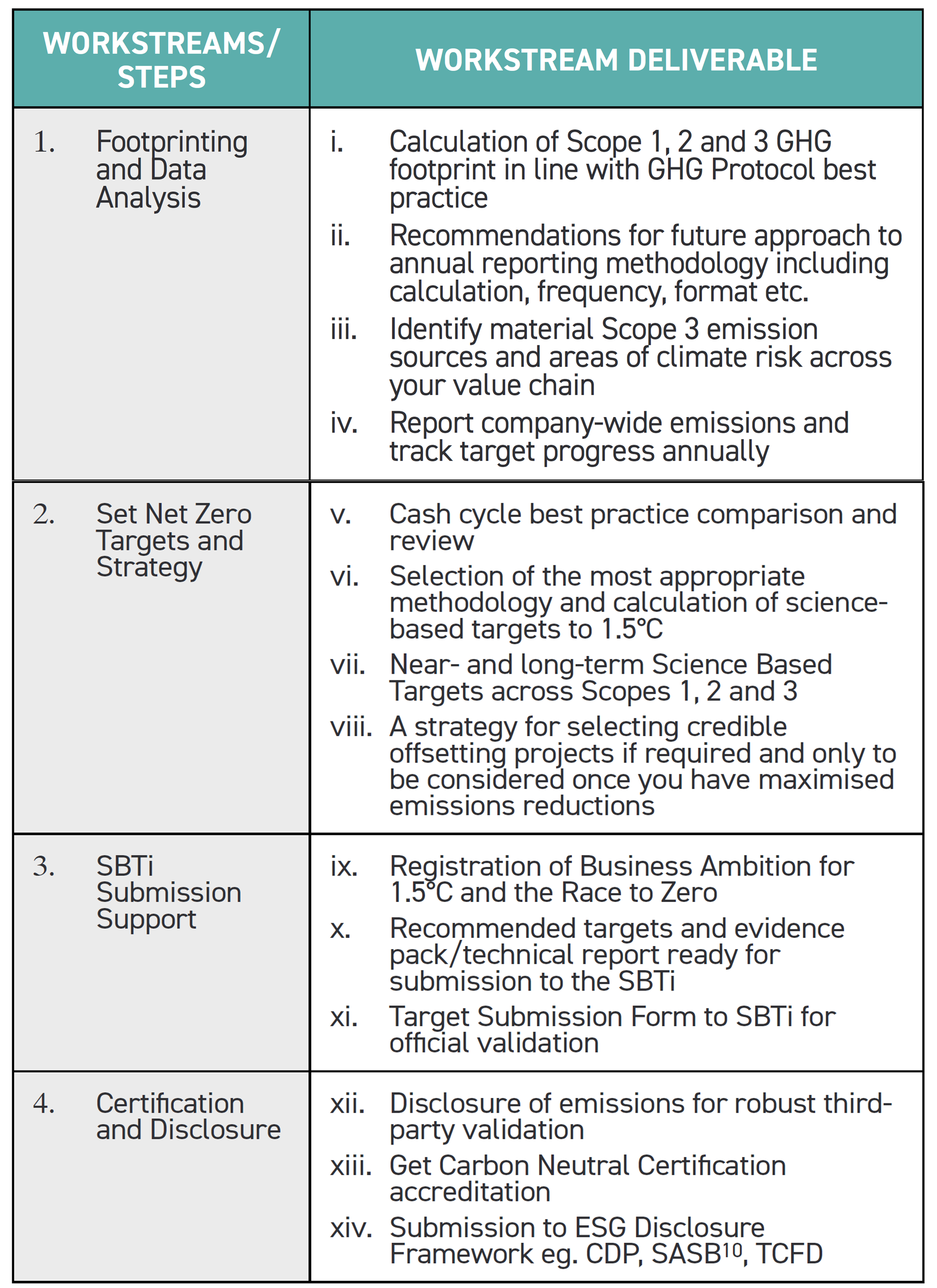
1. Measure your carbon footprint in accordance with GHG Protocol 1 and ISO 14064-1 2, and set Net Zero targets over time.
2. Create your plans to lower your emissions through energy efficiency/ reduction programmes in line with science-based targets.
3. Procure and transition to renewable energy.
4. Offset emissions that cannot be reduced to zero through carbon credit trading.
5. Put in place robust, recognised, transparent and verified reporting (which is straightforward to do) and certify your organisation as Carbon Neutral.
1. Measuring Your Environmental Impact and Carbon Footprint
The first task is to measure and record your current carbon footprint, especially your Scope 3 emissions. This allows you to decide where your organisation needs to focus and to set targets. It is also the basis for progress tracking, identifying the efficiencies and actions necessary and to be credible both internally and externally.
For central banks, a Life Cycle Assessment (LCA) of the cash cycle is a good starting point, giving a complete overview of the total environmental impact of cash. It allows central banks to validate all areas of action. Carrying out LCAs of coins and banknotes is well established and have been completed by a number of central banks such as the Dutch National Bank 3 and Swiss National Bank 4.
An LCA will look at the cash cycle from start to finish, including raw material extraction, recycled material, manufacturing, distribution, product use, recycling and disposal stages. It takes into account specifics such as volume data and all the nuances of the cash cycle in order to calculate the environmental impact over the entire life of cash.
An LCA needs to be written to meet the requirements of two ISO standards - 14040 5 and 14607 6. PAS 2060 7 is an option, applying to businesses, services, or goods. LCAs produced under PAS 2060 are independently validated or self-assessed 8 and are written to be made publicly available.
It is worth noting that to date no central bank has carried out an LCA of an electronic payment tool, which means it is not possible to compare the environmental impact across payment options.
Measuring the carbon footprint is a quicker and more focused exercise. The Bank of England carried a carbon footprint assessment out as part of its transition to a polymer substrate and then subsequently to validate what actually happened 9.
2. Setting Targets and Making a Plan
Once your priorities are set, the starting point for creating a roadmap to Net Zero is to set detailed targets, preferably targets that will be recognised outside your organisation, that are specific, measurable, achievable, relevant and time-bound.
The data will highlight across scope 1-3 the most significant sources of carbon emissions, and other environmental impacts. Although the people in the organisation know it best, many of the challenges and opportunities identified will have been faced by others. Input on what is best practice and how others have addressed the common problem areas will speed up change.
Using science-based targets
A good place to start in creating the plan and the targets within it, could be using the Science Based Targets initiative (SBTi) – see end of article.
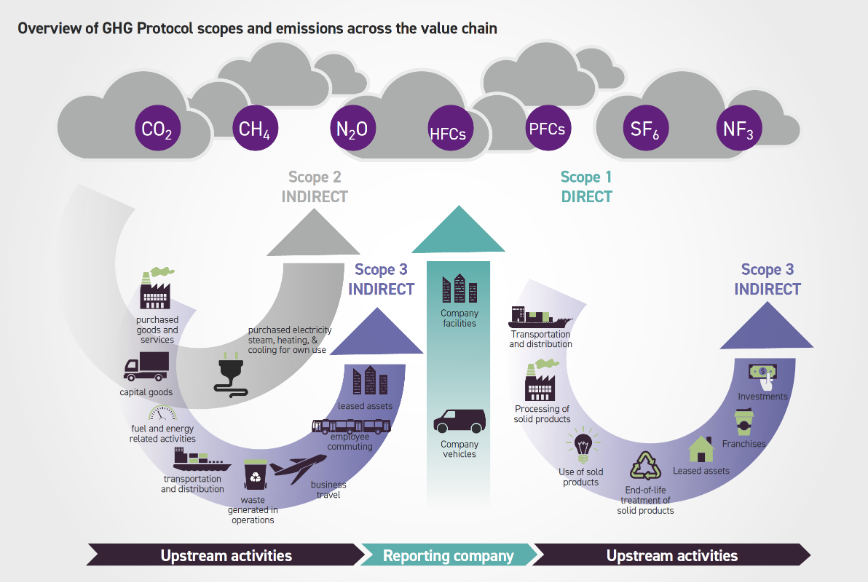
SBTi have launched a Net Zero Standard, providing an independent assessment of corporate Net Zero target setting. Companies adopting the Standard will be required to set both near- and long- term Science Based Targets across Scopes 1, 2 and 3. The image below provides a quick reference to each scope.
External expert help to create a roadmap and targets would normally include general guidance on steps to reduce emissions, hotspot analysis, setting detailed objectives and specific targets for emission reductions and longer-term actions.
The roadmap and targets will need estimates for both costs and any operational financial savings alongside the reduction in carbon emissions. These will need to be done alongside industry forecast data, assessments of the viability of emission reductions and long-term cashflow modelling where expenditure is required.
An important part of any plan is how to engage with the workforce so that they contribute to and support the changes required.
Target timespans
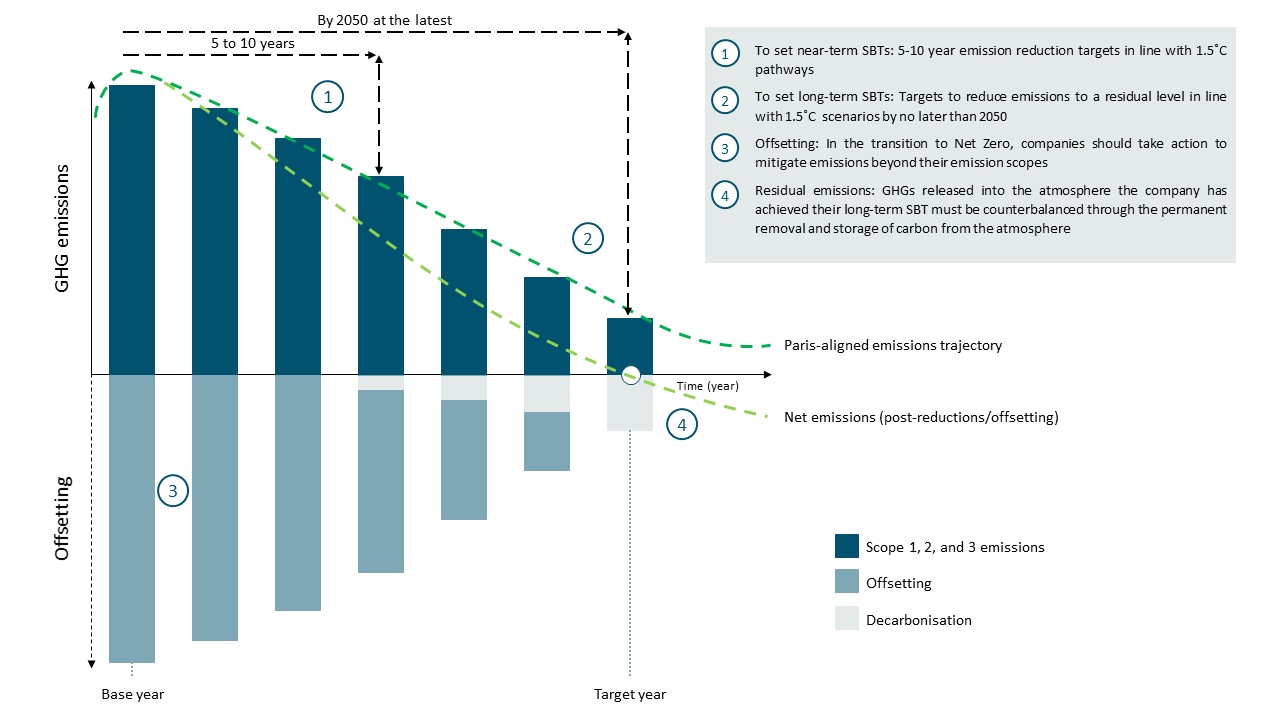
Within the context of the SBTi standard, a near-term target is considered to be the next 5-10 years. The 2015 Paris agreement set the goal of limiting the rise in global temperatures below 1.5°C. Aligning this with carbon reductions means a long-term target of reducing your absolute emissions by 90% or more.
The SBTi standard acknowledges that not all emissions can be eliminated, in which case carbon offsetting using carbon removal carbon credits is allowed. It is assumed that about 10% of emissions will need to be offset.
These statements are in line with changes to the near-term Science Based Target Criteria from July 2022, which are:
Scope 1 and 2 targets aligned to 1.5°C temperature reduction.
Scope 3 target aligned with 1.5°C temperature reduction, or well below 2.0°C.
All near-term targets must be 5-10 years, and should be updated every five years and progress reported annually.
Universal pathway: applicable to all organisations, 4.1% linear reduction (aligned to 1.5°C), or 2.5% linear reduction (aligned to well below 2.0°C, only applicable to Scope 3 emissions).
3. Procure and Transition to Renewable Energy
The production and management of the cash cycle is power intensive work. Alongside fossil fuels, electricity is the major source of the environmental impact of cash, particularly its carbon footprint. Using renewable energy is, therefore, likely to be a high priority action.
As described In the white paper ‘Cash: A Roadmap to Sustainability’ 11 the Royal Mint has a wind turbine, Oberthur Fiduciaire uses tidal power and nearly half of the 21 contributing organisations have their own solar energy which contributes at least some renewable energy to their work.
Switching to a renewable energy source from a third party requires significant due diligence to be confident that the source really is carbon neutral. You may need to decide how to categorise energy generated from burning waste or nuclear generated electricity. Again, there are experts who can advise.
4. The Benefit of Carbon Offsetting
Carbon offsetting has had a bad name in the past where it has been carried out badly. There is the need, therefore, to be confident that it really is doing what it is meant to do. As with everything else in the environmental space, it is complex and there are a multitude of options, standards and accreditation bodies.
Despite that, as the illustrative Net Zero roadmap shows, carbon offsetting may be necessary in the short term until the benefits of actions taken to reach Net Zero take effect. A separate paper will layout the landscape and options of carbon offsetting.
5. The Complexities, Challenges and Importance of Reporting
Environment, Social and Governance (ESG) reporting is now a major part of government, business and commercial life. Organisations are expected, and sometimes required, to report their activities. In order to report to a high and consistent standard in a way that is transparent and accurate takes considerable work.
ESG data should provide disclosures that meets global sustainability standards such as SASB, GRI 12, CPD and Task Force for Climate-related Financial Disclosures (TCFD) 13. This requires the collection, input, organisation and management of ESG data both for internal use and external reporting. There are a large number of software packages available to support this reporting and a wide range of organisations that can help set up reporting systems and approaches.
Some governments either mandate or set guidance about the required disclosures. In the UK, complying with the TCFD is voluntary. However, the UK government has stated its intention to make TCFD-aligned disclosures mandatory by 2025, and according to their planned roadmap this would include all UK-registered companies complying in 2022 and reporting against governance, strategy, risk management and metrics and target criteria.
THG Eco: Sustainability Support and Advice
Who are THG?
THG (www.thg.com) is a quoted company in the top 100 FTSE listed companies which has developed an environmental consultancy business.
THG is a major e-commerce company with its own brands based on its own proprietary, end-to-end, e-commerce technology, infrastructure, and brand-building platform (THG Ingenuity). It supplies an online and global customer base and also supports other third-party brands. It has, therefore, extensive manufacturing and distribution experience.
Who is THG Eco?
THG Eco was created to deliver THG’s own sustainability and ESG strategy. THG Eco now uses what it learnt to support other organisations wanting to develop their own plans.
What does THG Eco do?
THG Eco delivers competitively priced, comprehensive roadmaps to Net Zero for a wide range of organisations around the world, industrial and consumer based. It is able to provide Life Cycle Analysis and Carbon Footprint Analysis and a wide range of data services. When working with clients it delivers plans with a clear trajectory to achieve Net Zero, and the period over which they will be run.
THG Eco has a proven process for creating clearly defined paths that reduce greenhouse gas emissions, helping prevent the worst impacts of climate change and future-proofing your organisation and sector. THG Eco has a well-developed expertise in carbon offsetting of all kinds around the world.
Finally, it also provides reporting support and advice, or a full service including appropriate software, if needed, for central banks or cash cycle stakeholders.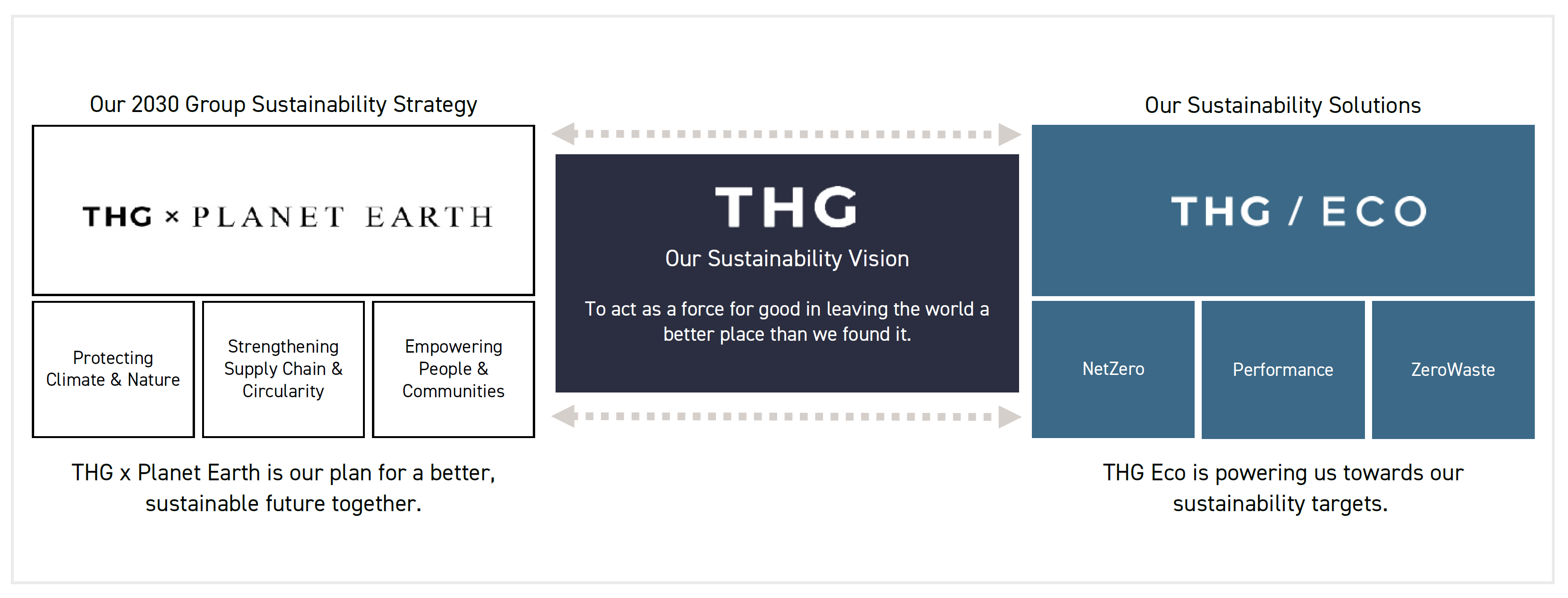
SBTi is a collaboration between CDP, the United Nations Global Compact, World Resources Institute (WRI) and the World Wide Fund for Nature (WWF). Since 2015 more than 1,000 companies have joined the initiative to set a science-based climate target.
The CDP is an international non-profit organisation based in the UK, Japan, India, China, Germany and US that helps companies and cities disclose their environmental impact. It aims to make environmental reporting and risk management a business norm, driving disclosure, insight, and action towards a sustainable economy. Since 2002 over 8,400 companies have publicly disclosed environmental information through CDP.
The United Nations Global Compact is a voluntary initiative based on CEO commitments to implement universal sustainability principles and to undertake partnerships in support of UN goals.
WRI is a global non-profit organization that works with leaders in government, business and civil society to research, design, and carry out practical solutions that simultaneously improve people’s lives and ensure nature can thrive.
The World Wide Fund for Nature is an international non- governmental organisation, founded in 1961, that works in the field of wilderness preservation and the reduction of human impact on the environment. It was formerly named the World Wildlife Fund, which remains its official name in Canada and the US.
References
1 - The GHG Protocol establishes comprehensive global standardized frameworks to measure and manage greenhouse gas (GHG) emissions from private and public sector operations, value chains and mitigation actions. GHG Protocol’s Corporate Accounting and Reporting Standard provides the accounting platform for virtually every corporate GHG reporting program in the world. In 2016, 92% of Fortune 500 companies responding to the CDP used GHG Protocol directly or indirectly through a program based on GHG Protocol.
2 - ISO 14064, part of the ISO14000 standard, provides governments and businesses with a set of tools for programs to quantify, monitor, report and verify greenhouse gas emissions. ISO 14064 supports organisations to participate in both regulated and voluntary programs such as emissions trading schemes and public reporting using a globally recognised standard.
3 - Life cycle assessment of cash payments (dnb.nl)
4 - Swiss National Bank (SNB) - Life cycle of a banknote
5 - ISO 14040 describes the principles and framework for LCAs including: definition of the goal and scope of the LCA, the life cycle inventory analysis (LCI) phase, the life cycle impact assessment (LCIA) phase, the life cycle interpretation phase, reporting and critical review of the LCA, limitations of the LCA, the relationship between the LCA phases, and conditions for use of value choices and optional elements.
6 - ISO 14607 specifies principles, requirements and guidelines for the quantification and reporting of the carbon footprint of a product (CFP), in a manner consistent with International Standards on life cycle assessment (LCA) (ISO 14040 and ISO 14044).
7 - BSI PAS 2060. PAS 2060 is a specification detailing how to demonstrate carbon neutrality produced and published by the British Standards Institution.
8 - The final report includes a qualifying explanatory statement signed by both the commissioning organisation and the report writer.
9 - Carbon Footprint Assessment (bankofengland.co.uk)
10 - Sustainable Accounting Standards Board – UK guidance
11 - https://reconnaissance.net/cash-industry-maps-out-route-to-sustainability/
12 - The Global Reporting Initiative (GRI) is an international independent standards organization that helps businesses, governments and other organizations understand and communicate their impacts on issues such as climate change, human rights and corruption.
13 - TCFD: The UKs Financial Stability Board created the Task Force on Climate- related Financial Disclosures to improve and increase reporting of climate- related financial information. The TCFD has developed a framework to help public companies and other organizations more effectively disclose climate- related risks and opportunities through their existing reporting processes.
Subscriber content
Read the full article
Full access to Cash & Payment News articles, newsletters and archives.