
News in Brief


COVID-19 Banknote Transmission Remains a Concern in Taiwan
Fear of COVID-19 transmission by banknotes remains in Taiwan despite the worldwide research that demonstrates the risks are extremely small, no more than touching any other object in a public space.
In the run up to the Lunar New Year, the Bank of Taiwan, which is state-owned, has put only new NT Dollar banknotes in 765 ATMs as part of the government’s efforts to reduce COVID-19 transmission.
It is customary to exchange used notes for new ones as part of the ‘red envelopes’ tradition of giving family members money to wish them good fortune.
MAS ‘Good-as-New’ Initiative Reduces Note Demand
In 2013 the Monetary Authority of Singapore (MAS) launched a ‘good-as-new’ initiative for the S$2 at the Lunar New Year. Since then, the demand for new S$2 notes at that time of year has dropped by about 20% each year. This represents an important saving because the number of S$2 notes far exceeds those needed for normal circulation requiring the excess to be destroyed.
MAS issues about 100 million new notes for the Chinese New Year and other festive periods.
Note Life Extends in South Korea
Lower circulation velocity of banknotes in South Korea due to a move to more online transactions is reported to be increasing note life.
The Bank of Korea estimates the highest value banknote, the 50,000 won, now lasts four months longer, 15 years. The 10,000 won lasts 11 years and the 1,000 won five years.
Central Bank of Egypt Promotes Electronic Payments
The Central Bank of Egypt is pursuing a policy to encourage people to pay electronically to increase financial inclusion.
As part of this programme, it has set a maximum daily limit of LE20,000 for cash withdrawals and deposits at ATMs. There is no limit on electronic payments.
The Bank has also extended the requirement for banks not to charge fees on withdrawal or balance enquiries at ATMs until the end of June 2022, to cancel charges for bank transfer services denominated in Egyptian pounds and to require electronic wallets to be issued free of charge. It has stopped commissions and fees for electronic fund transfers between mobile phone accounts and from mobile phone accounts to bank accounts.
Financial inclusion is seen as being a route to reduce poverty, level up income differences, increase financial stability and drive economic growth. Fintech solutions are often promoted as the route to financial inclusion, but talking about it is easier than doing it.
The goal is to make day-to-day financial activity low cost and easy to do. Security is taken as read. If this can be achieved, then the underbanked communities can be helped to switch from traditional banking services to digital-driven transactions. Egypt has seen the underbanked population fall by 35% in the last decade as mobile phone penetration has increased. A 2020 Harvard University thesis1 found that only a third of the adult population had full access to financial services.
In order to increase financial inclusion, the government in Egypt has taken steps to improve the legal and regulatory framework for digital financial services, reduced transaction costs and focused on financial literacy initiatives with the help of educational programs, media outlets, government incentives, and other promotional activities.
DNB Investigates CViT Supplier Options
The Dutch National Bank (DNB) is making an inventory of suppliers who can provide international cash and valuables transport for them, particularly for banknotes and key pieces such as banknote components. The movements are from DNB’s premises in the Netherlands to other locations in the EU, EEA, UK, Switzerland, USA or Japan, as well as within the Netherlands.
The maximum value transported is €15 million. The DNB spends approximately €50,000 each year on such movements.
Suppliers must have a private security industry license for being a Cash and Valuable in Transit (CViT) company, issued by the Dutch Ministry of Justice; or an equivalent licence in the country of establishment, and be able to abide the laws and regulations applicable to CViT movements.
Croatia Prepares for the Euro
Croatia hopes to hear in July this year whether it can join the Eurosystem and adopt the euro as its currency with a possible issue date of January next year. Bulgaria is also waiting to hear but with a later launch date of 2024.
The Croatian National Bank has urged people to deposit their kuna banknotes into banks to make the transition easier. 36 billion kuna ($5.4 billion) is in circulation. Although people will be able to exchange kuna for euros until 2023 (or later if at the central bank), in other countries experience shows that people tend to exchange the vast majority of their legacy currency extremely quickly.
The Bank estimates the total cost of switching to the euro will be 916 million kuna ($138 million), while commercial banks estimate it will cost them an additional billion kuna in lost exchange fees. It will, though, reduce their currency risk and improve stability.
ADT and Deposit ATMs Volumes Growing
Automated deposit terminals (ADT) can issue notes and receive cash deposits. An RBR 2 report, ‘Deposit Automation and Recycling 2022’, says that ADT numbers grew 1% in 2021 to 1.6 million units worldwide. Recyclers are driving this growth, accounting for 65% of ADTs.
The price gap between recyclers and non-recycler deposit ATMs is closing at the same time as CIT costs are rising, making ADTs more cost effective. It appears ADTs are being promoted primarily on grounds of efficiency and cost reduction, with the sustainability benefits given little prominence.
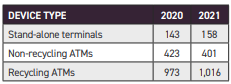 Number of automated deposit terminals worldwide by type (thousands).
1 - Nada, Rania H. 2020. Financial Inclusion and Sustainable Growth in Egypt. Master’s thesis, Harvard Extension School.
2 - RBR is a strategic research and consulting firm.
Subscriber content
Read the full article
Full access to Cash & Payment News articles, newsletters and archives.