
Bank of England Making Progress on its Environmental Targets


The Bank of England has issued its climate related financial disclosure document for 2022, which builds on the significant progress made in 2021.
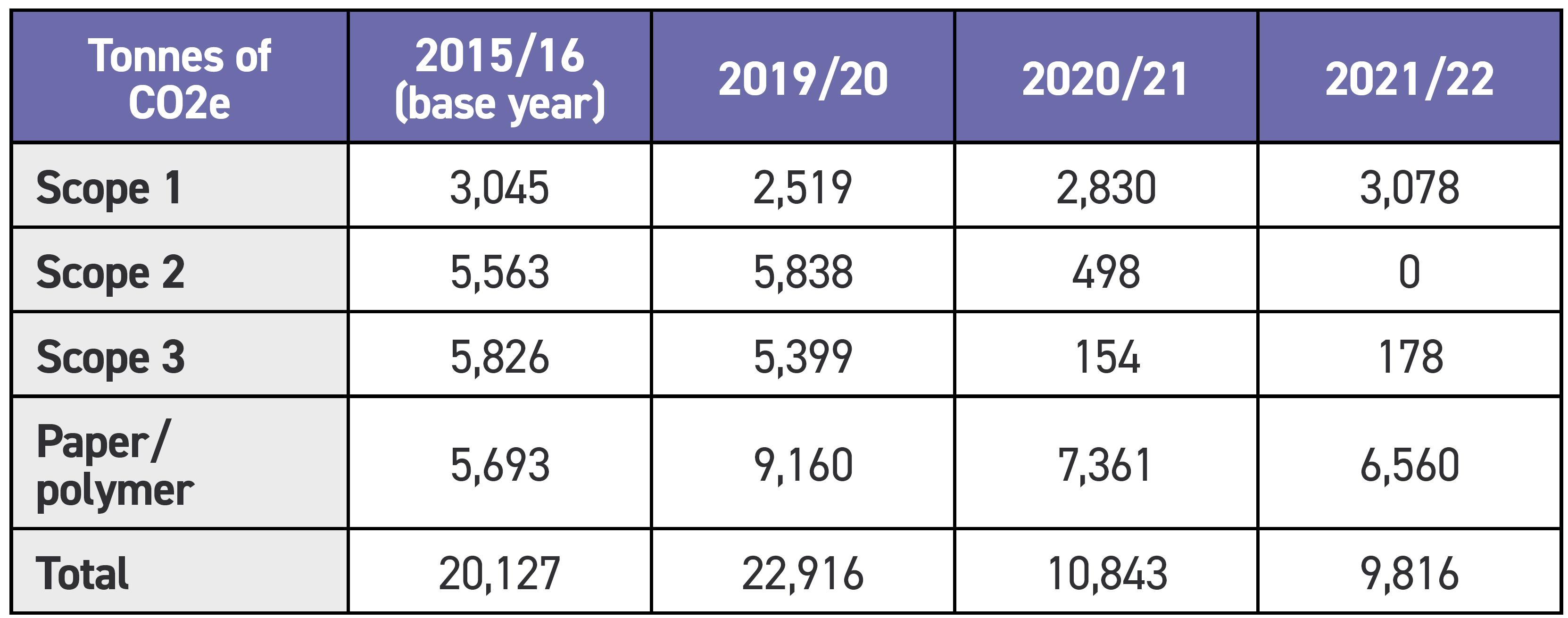
The Bank has set itself the target of reducing its Green House Gas emissions by 63% between its base year of 2016 and 2030. This target is set so that the Bank plays its part holding temperature increases to 1.5%. The Bank reduced its carbon footprint by 53% in 2021 and a further 9% reduction in carbon emissions in 2022. It is on track to meet its target.
The Bank has now set a further target which is to reduce its emissions to Net Zero by 2050 at the latest. This target is consistent with the Climate Change Act 2008. The Bank will publish its Net Zero transition plan in 2023.
Initiatives
2021 saw significant activity to allow the Bank to be confident that it is on track. This included:
Moving to renewable sources of electricity.
Significantly less air travel.
Installing an integrated energy monitoring system to optimise energy use.
Lower production volumes of polymer substrate banknotes.
Signing new procurement contracts with its polymer substrate suppliers committing them to achieving carbon neutrality for future contracted supplies.
Outsourcing its technology estate to a third-party supplier which has more modern facilities and updated technologies. It also has larger scale operations allowing greater energy efficiency.
Moving some of its technology estate to cloud-based services.
Embedding environmental considerations in procurement processes.
The Bank won the 2020 Institute of Environmental Management and Assessment’s award for sustainable procurement. The Bank has now appointed an external provider to assess key suppliers and to rate them on sustainability and emissions in order to reduce its scope 3 emissions.
2022 has seen the Bank continue to optimise its building’s management systems and continue its work on rating suppliers. The Bank is looking to develop a new ‘Northern Hub’ in the UK and to enhance its regional presence in England and the other nations. It is committed to taking into account carbon emissions and the environmental impact of this work.
The pandemic has seen a change in working operations and the Bank is looking at the impact of this, particularly if home working is to continue. It carried out a staff survey exploring questions such as how many people are working at home at the same time, what heating systems are used and do people use renewable energy.
While the Bank’s office infrastructure and carbon emissions are relatively fixed, it looked at scenarios of home working. If people use renewable energy, then home working appears to have a significant positive impact. Considerable additional work is needed to be confident in the findings.
The Bank is commissioning a Life Cycle Analysis for banknotes to better understand their environmental impact.
Physical operations
The most significant contributors to the Bank’s carbon footprint are its use of natural gas and polymer substrate. In 2021 this was 24% and 68% respectively, in 2022 30% and 67%. In both 2021 and 2022 the Bank’s move to using renewable energy sources and lower production volumes of polymer substrate, along with supplier initiatives to reduce their carbon usage, have driven the reduction in the Bank’s carbon usage.
Although total electricity consumption remained in line with prior trends, emissions associated with electricity consumption were eliminated in 2021/22 due to the Bank’s purchase of renewable electricity matched by Renewable Energy Guarantee of Origin (REGOs) and since a full year effect occurred, unlike 2021. This means that although the actual electricity supplied to the Bank will come from the National Grid, which draws electricity from a range of sources, both renewable and non-renewable, the Bank’s electricity supplier will be obliged to purchase the same amount of renewable electricity.
Within the Bank’s scope 1 are its use of gas, oil (for generators), vehicles and refrigerants. Scope 2 is entirely electricity, hence the major reduction in 2020/21 with the move to renewable electricity. Scope 3 includes indirect use of electricity, air and rail travel, water, office paper and waste.
Banknote related carbon emissions
For banknote substrate the CO2e figures are:
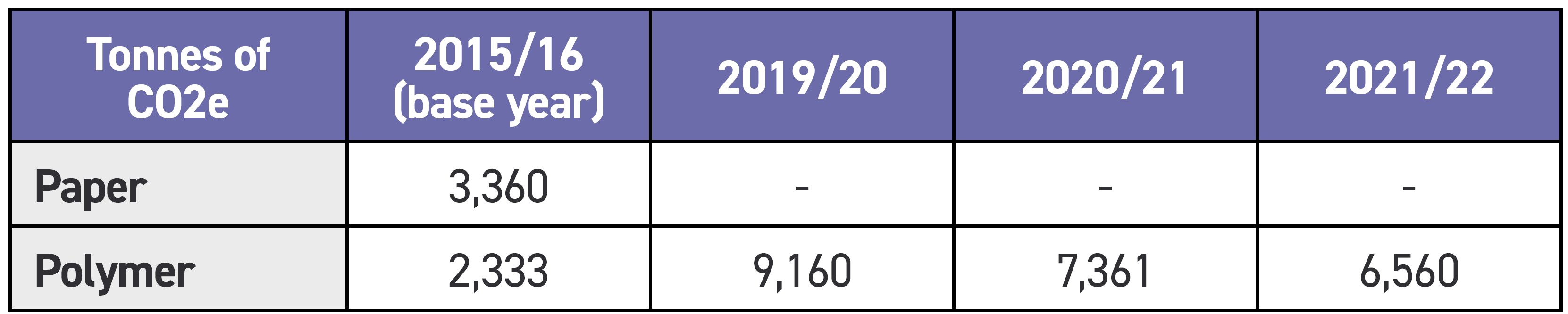
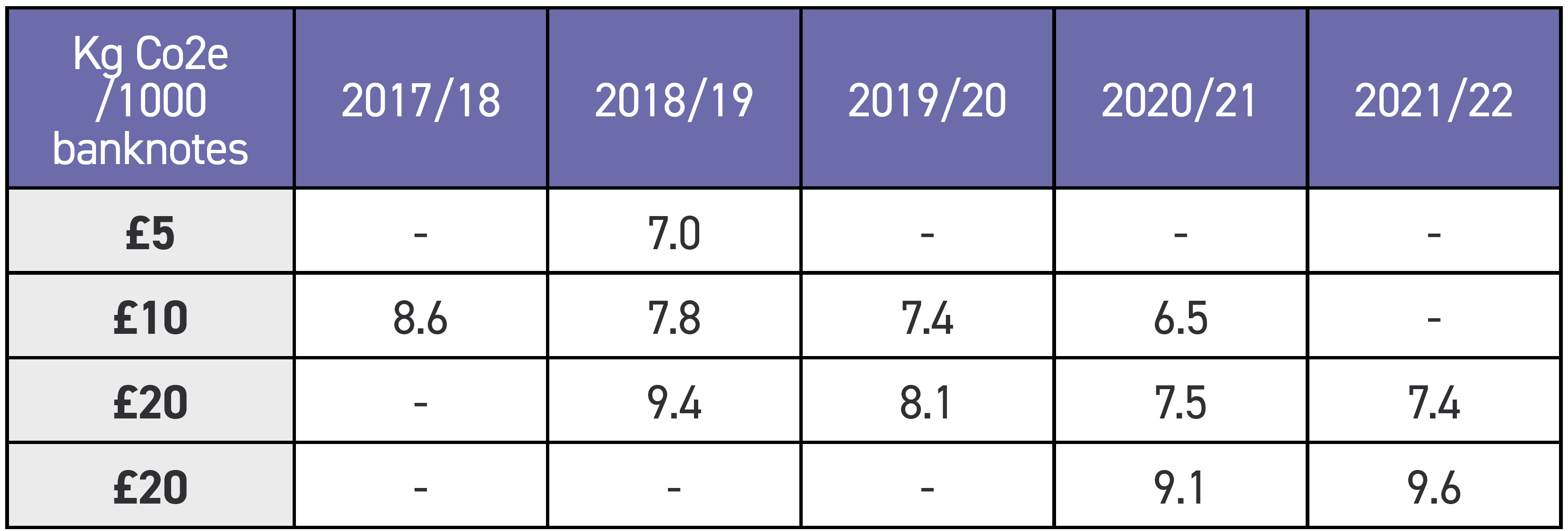
The carbon emissions relating to banknotes are not part of the 2030 target being pursued by the Bank. This is because banknote demand is not in the control of the Bank.
The carbon emissions from polymer substrate are still reported by the Bank, but the carbon reduction initiatives being pursued by the suppliers and the benefits of the carbon offsetting bought by them is reported in their carbon data.
Final word
2021 saw the Bank move forward on a wide range of fronts while 2022 appears to have been a period of consolidation, particularly around supplier ratings and Zero Waste planning.
The report emphasises how some of the gains from home working, less travel and lower banknote production volumes make it vulnerable to a reversal in its gains, but the Bank is confident that its 2030 goal is achievable.
Subscriber content
Read the full article
Full access to Cash & Payment News articles, newsletters and archives.