
News in Brief


Ugandan Florists Have Fun With Banknotes
Perhaps a minority story, but a real life example of the strange things people do with banknotes. In Uganda, there is a trend for florists to design bouquets using banknotes. There is a custom to present bouquets to children as they face their national exams. The central bank is not impressed and has warned that doing this compromises the integrity of the banknotes and has pointed out that this is illegal.

The problem is that the florists use glue, sellotape, pins and other adhesives and fasteners in their creations, damaging the integrity of the banknotes. Often this means they will no longer work in counting machines and ATMs. It can lead to their premature withdrawal from circulation.
Korean ATMs Accessed by QR Codes
17 Korean banks launched a QR code- based ATM deposit/withdrawal service on 6 December. Customers can use ATMs with mobile cash card applications and mobile banking apps, irrespective of the smartphone model they have. No physical cards are needed.
Up to now, only customers with Android phones have been able to use this kind of service, and only on ATMs working with near field communication devices (NFC).
With the new QR code-based service, NFC enablement is no longer needed and any type of phone can be used.
ECB PEF Identifies Banknote Environmental Impact
The European Central Bank (ECB) has issued the findings of its Product Environment Footprint (PEF) study focusing on the creation and life cycle of banknotes through to their disposal when they become unfit to circulate.
As with other Life Cycle Assessments (LCAs), this PEF also found that the energy consumption of automated teller machines (ATMs) and transportation had the biggest impact, followed by the processing of banknotes by National Central Banks, paper manufacturing and the authentication of banknotes in shops. This last finding is different from other LCAs.
The PEF found that ATM manufacturers have made ATMs more energy efficient, reducing their environmental footprint between 2004 and 2019 by 35%.
Ireland Grapples with Access to Cash
Ireland is the latest European country to take action to safeguard access to cash. A retail banking review was published in November 2022, the first review since the 2013 National Payments Plan. Since then, nine of Ireland’s 12 banks have amalgamated or closed down, or exited the Irish retail banking market.
In addition, payments made in cash at point of sale have fallen to 16%, although the central bank says 73% of adults still use ATMs regularly, albeit the total number of withdrawals has fallen 33% since the start of the pandemic.
As a result, the Finance Minister is bringing forward legislation to safeguard public and business access to cash, establishing maximum distances people have to travel to get cash in rural areas. In urban areas the requirements would be linked to the size of the population.
The Finance Minister is also, separately, looking to define ‘essential services’ which would have to accept cash payments, such as grocery shops and pharmacies. Public services are also likely to be required to accept cash payments, or to facilitate cash payments. Ireland’s vehicle testing service announced it would move to cash payments this year, causing an outcry that forced it to reverse the decision.
The proposed legislation includes mandating the central bank to authorise and supervise ATM operators and cash-in- transit companies.
As well as combining different metrics to ensure there are adequate services across the country to meet need, the Access to Cash Bill will require ATM operators and cash-in-transit companies to be authorised and supervised by the Central Bank of Ireland.
The Pain of Paying with a High Value Banknote
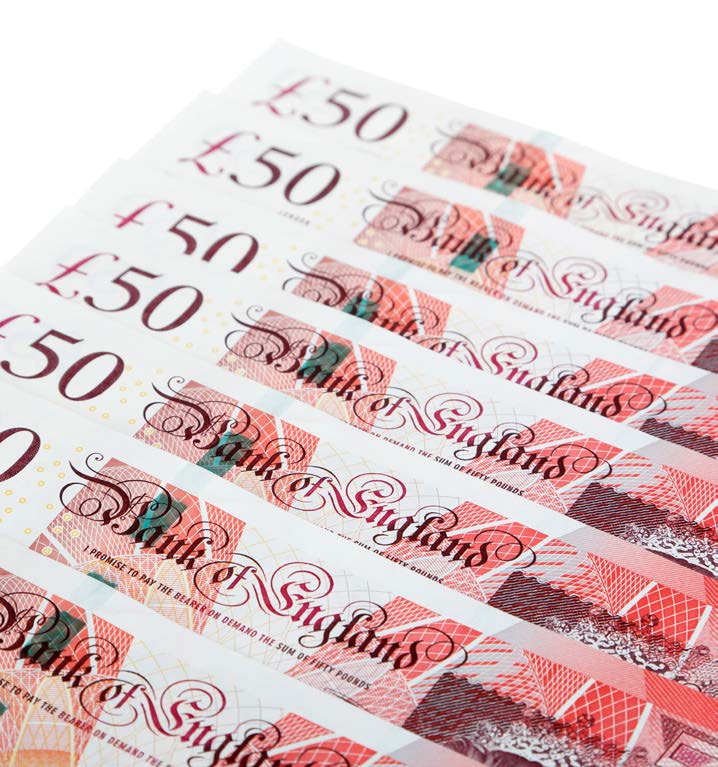
The UK has an odd relationship with the £50 banknote. £50 is not, of course, a particularly high value note, but a recent article on Yahoo! News told the story of the correspondent’s experience paying with £50 notes, or trying to.
There appears to be a widespread distrust of accepting a £50 note. Distrust should, however, have reduced given that the Bank of England standardised the design so that it was clearly a continuation of the £20 in terms of size progression, feature selection and feature layout. But that appears not to be the case.
For shops, a £50 counterfeit still represents a significant loss of earnings. Other than a handful of ATMs, they aren’t issued by ATMs and so they are hard to get and are seldom seen. Given the seemingly mass closure of UK bank branches, there aren’t many tellers issuing them. Perhaps the move to less cash is also contributing to unfamiliarity with the note.
There is a perception, as Yahoo found out, that £50 notes are used by drug dealers and others engaged in illegal activities. Certainly, in the 1980s a TV comedy programme created the idea that £50 were part of a ‘loads of money’ culture of brash consumerism. Using a £50 banknote gave off signals that were not entirely ‘proper’ or ‘nice’. The 1980s are rather a long time ago but using £50 continues to be considered somewhat showy.
There is little research into why the £50 is so seldom used but perhaps a mixture of logistics and culture lies behind this strange anomaly of the UK.
Subscriber content
Read the full article
Full access to Cash & Payment News articles, newsletters and archives.