
News in Brief


South Korea ATMs to be QR Code Enabled
The Bank of Korea is planning to introduce a QR code-based ATM deposit and withdrawal service this year. There is already a Near Field Communication (NFC) based service and 43% of South Korea’s 106,000 ATMs are NFC enabled. Mobile phones have a mobile cash card built into them.
When this service is in place, iPhone users will be able to make deposits and cash withdrawals, as well as Android users, and this function will be possible irrespective of whether the ATM belongs to the customers bank or not.
Cash Digitisation in the US
A recent US newspaper article suggests that some stores and restaurants are installing ‘reverse ATMs’ to allow people to change cash into stored-value cards. The suggestion is that this is a response to cities (New York, Washington DC, San Francisco and Philadelphia) and states (New Jersey, Colorado) which are passing laws requiring them to accept cash payments.
Venues ask customers to use their cash to buy pre-paid cards and then use these to pay them. The retailer buys the machine to reduce the cost and risk of handling cash. Generally, the consumer does not pay to buy the card, usually from Visa or Mastercard. The merchant pays the interchange fee charged by Visa or Mastercard as they would with any other card payment.
Some cards carry a ‘dormancy fee’ which is charged if the card isn’t used for more than three months. This tends to happen if a small balance is left over.
Cash Under Pressure in the UAE
The FIS Global Payments Report 2023 reflects changing payment trends in the United Arab Emirates (UAE). At the point of sale (POS) cash is used in 18% of transactions, just ahead of debit cards, 17%, but far behind credit cards, which are at 40%. Digital wallets have reached 16%.
Online, the gap between payments made by card and digital wallets is closing. Credit cards are used for 41% of payments but wallets, with a 24% share, have overtaken debit cards, which are at 11%. Cash is still in the mix with cash on delivery being at 7%.
In the wider Middle East Africa (MEA) region, cash use at the POS has fallen from 73% in 2018 to 43% today. Digital wallet use at the POS was at 13% in 2022 and 25% for online payments.
New Service to Help Explore Biodegradability of Banknotes
Biobanknote, who took part in the recent Cash & Payments Sustainability Forum™ online seminar on repurposing unfit cotton banknotes, has developed a new service to help central banks understand and explore options for composting their banknote shreds.
A frequent question is whether countries’ banknotes are biodegradable. Biobanknote has worked with a local laboratory to carry out an analysis to determine what enzymes and microorganisms are required and how long it will take for the banknote to biodegrade. Effectively this determines the level of composting required and the ‘recipe’ to achieve a high-quality soil amendment.
Central banks can either send shredded banknote waste samples to Biobanknote for each denomination, or specimen banknotes. Biobanknote also suggests banknote and security printers and paper makers could consider including this in the specifications of their cotton paper references and to be within the parameters required by their customers.
HKMA’s Practical Sustainability Road Map
The Hong Kong Monetary Authority (HKMA) has issued its first standalone sustainability report.
In 2022, HKMA achieved a double-digit reduction on a per-capita basis across its greenhouse gas (GHG) emissions, total energy consumption and total paper consumption, compared with the 2015 level when it started to track its carbon footprint.
HKMA aims for net zero across Scope 1, 2 and 3 by 2050 at the latest. It is taking actions such as replacing existing vehicles with electric vehicles and procuring renewable energy certificates (REC) to be confident that its energy is genuinely renewable. It will reduce its Scope 2 emissions based on RECs by 63% by 2030. Travel related emissions, which are Scope 3, will be removed or offset from this year. HKMA is using the Hong Kong Quality Assurance Agency to verify its target setting and emissions.
To save energy HKMA is installing LED lighting, motion sensors and auto timers for all of its offices. Air-conditioning is being set at 25° C and office equipment will use their power-saving mode.
HKMA’s energy consumption is already 24.4% lower than in 2015 and its Scope 1 and 2 GHG emissions are 38.2% lower.
For banknotes and coins:
HKMA is encouraging the public to use electronic channels and to reduce the usage of physical red packets (Lai sees) and banknotes.
A Coin Collection Programme spearheads the HKMA’s efforts in the recycling of coins. Two Coin Carts, equipped with two high-speed coin counting machines, collect coins from the public, who are given the choice of exchanging their coins for banknotes, topping up their accounts managed by Stored Value Facilities, such as Octopus cards or e-wallets, or donating to the Community Chest charity.
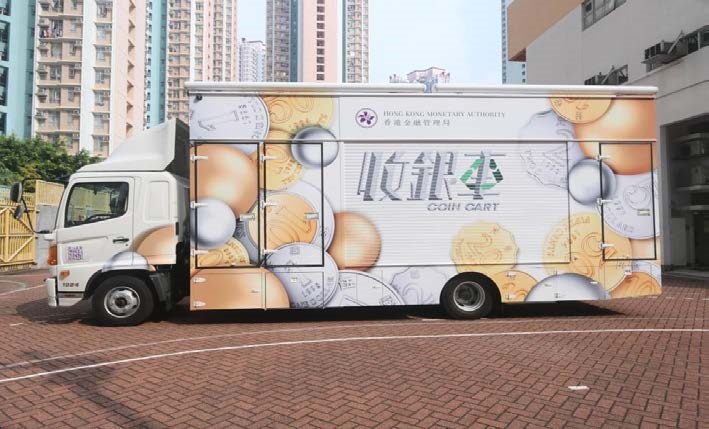
The coins collected are recirculated to meet public demand, making circulation more efficient, and at the same time reducing the need to mint new coins. So far, the carts have served over one million people and collected more than 800 million coins with a total face value of approximately HK$1.3 billion.
Estonia Cash Issues Rise
The central bank of Estonia, Eesti Pank, issued 11% more banknotes in the first quarter of 2023 than the previous year. ATM withdrawals were unchanged compared with a year earlier; however, cash deposits were up 12%. 248 of the 664 ATMs in Estonia allow cash depositing. There are 20 bank branches and about 700 shops where cash can also be withdrawn.
Estonia still uses one and two cent coins, and these made up 45% of the 4.7 million coins put into circulation. Although rounding rules were discussed in 2018, no decision has been made to introduce them. 2.6 million coins were returned to the Bank.
Subscriber content
Read the full article
Full access to Cash & Payment News articles, newsletters and archives.