
The Flight to Cash in a Crisis

Gerhard Rösel and Franz Seitz have published a paper, ‘Cash and Crises: No Surprises by the Virus’, as a working paper for the Institute for Monetary and Financial Stability*.
This paper looks at cash usage across a number of key economies since the 1990s.
It notes the trend towards cash being hoarded as a store of value, reflected an increasing proportion of cash in circulation being high value notes, but looks, in particular, at what happens to cash when there is crisis.
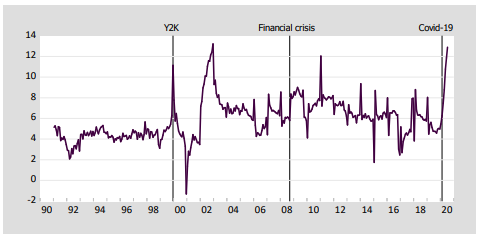
Irrespective of what underlies the crisis, the response is similar, people withdraw and hold more cash.
Defying apparent logic and the huge growth in the use of electronic payments, cash in circulation as a percentage of GDP has consistently risen faster than GDP in major advanced economies, eg. the US, Europe, Switzerland, the UK and Japan.
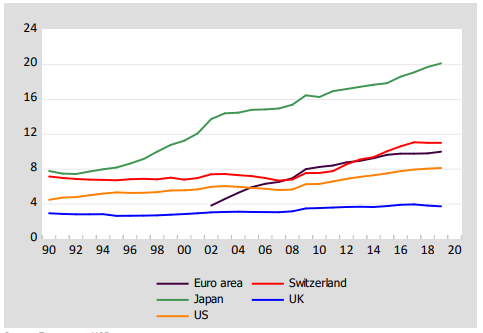
From the 1990s interest rates have declined sharply, reducing the cost of holding cash. Economic theory says that people will choose to hold more cash as a result, and this has happened. Taking that into account, the paper studies three crises – the 2000 technological crisis (known as Y2K at the time), the financial market crisis of October 2008 and the natural disaster that is the 2020/2021 COVID-19 crisis, to understand how cash usage and holdings changed when they happened.
Y2K crisis
The Y2K crisis was a fear that the millennium might confuse computer programmes, causing chaos – which included ATMs and payment systems shutting down. Demand for cash was, therefore, a mixture of protecting yourself against the chaos and holding cash for transactions.
Simplistically, it is credible to this translating to people wanting low denomination notes for transactions and high denomination notes to store value. In the US the demand for $100 notes went up 20% and the lower denomination notes 25%. Vault cash holdings were also increased by the banks as a precaution.
The response was not uniform. Germany’s vault holdings were significantly greater than in the US. People in Japan and Switzerland withdrew significantly more high denomination notes rather than low. In the UK it was largely low denomination notes. In Germany the mix was almost even, and this had been true during the Gulf War, the breakdown of the Soviet Union and the European Monetary System crisis of 1992/3.
Confidence returned swiftly when the feared technological crisis did not happen.
2008/9 financial crisis
Doubts about the safety of the global financial system caused the demand for $100 notes to rise, up 14% in October 2009, as people wanted to hold cash to protect themselves against bank failure.
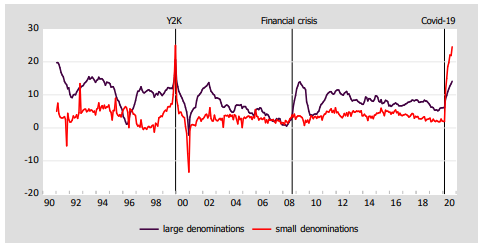
In the euro area, the UK and Switzerland demand was also for high denomination notes. In Switzerland the increase was even greater than in 2000. The crisis barely affected Japan.
2019/20 COVID-19 crisis
The response to the crisis has differed between countries, with the US and the euro area seeing demand for low denomination notes greater than for high, while in Switzerland and Japan it was the other way around. In the US the banks stockpiled notes in anticipation of higher cash demand.
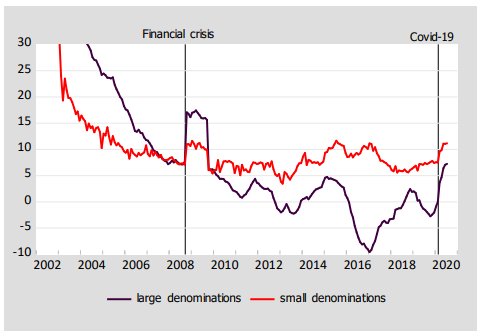
In the UK, both denominations appear to have been in demand. Even the less cash economies of Scandinavia saw an increase in the demand for cash in the form of high denomination notes.
Reflections on what is happening to cash overall
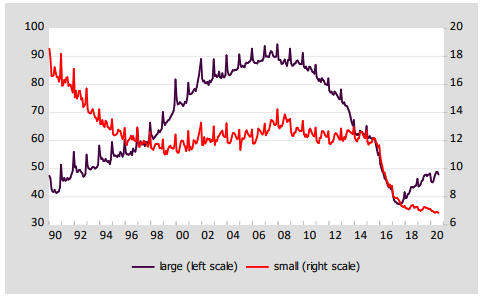
Transactional use of cash appears to be falling, with more cash held for non-transactional purposes. The holding of high value notes is not even, though. In 1990 60% of Japan’s yen were high value notes, US dollar 28%, deutschmark 8% and Swiss franc 3%. Today half of the value of dollars is $100 notes, the yen has fallen to 32% and the euro 13%. For the US, the ECB and Switzerland, their currencies are, in addition, hoarded outside their borders.
The report ends by reflecting on the importance of cash in these major economies when crisis happens. It clearly provides the public with reassurance, ‘insurance’, at difficult moments. Cash can, of course, create ‘moral hazard’, but restricting cash or allowing cash volumes to fall to the point where it is uneconomic for retailers and banks to sustain removes a highly valued insurance policy for society.
* Working paper series: 150 (2021). Institute for Monetary and Financial Stability: Goethe University, Frankfurt.
Subscriber content
Read the full article
Full access to Cash & Payment News articles, newsletters and archives.