
The Need for a New Cash Calculation


David Fagleman, of the consultancy Enryo, has recently presented and written about cash in circulation (CIC). He makes the case that CIC data provided by central banks is unhelpful because it overstates the case for cash usage and creates confusion about what is actually happening.
CIC includes cash used for transactions, cash held in the cash cycle for use in bank branches and ATMs, cash held overseas, cash that has been legitimately hoarded as a store of value and cash held in the shadow economy. It includes old series banknotes that have not yet been redeemed for the latest series and high denomination banknotes that seldom circulate. As a result, not all of the CIC is actually useful or usable.
Although the reduction in cash usage in the UK started some time ago, the decline accelerated in 2020. In 2010, UK Finance estimated 56% of transactions were settled in cash, but that this was down to 17% in 2020.
Despite that, research Enryo carried out in 2020 showed 11.6 million Britons, 22%, used cash once a week and 2.6 million used it daily. Age Concern, a UK charity, reported 2.4 million people aged 65 or over rely on cash for their daily lives. Cash usage remains a big deal.
Cash paradox
The ‘cash paradox’ is clearly seen in the UK. Cash transactions down to 17% while CIC rose £10 billion to £80 billion, and it is double what it was in 2008. At the same time, there are 13% fewer ATMs and 28% fewer bank branches.
The thought that the £10 billion is being hoarded or, as the Bank of England has suggested, held by sole traders who were unable to deposit it in the banking system during the lockdowns of 2020/21, is contradicted by Enryo’s research that shows only 17% or respondents were holding more cash than at the start of the pandemic. 9 million people would have had to withdraw and additional £1,070 each to account for the increase.
In the Bank’s CIC figures is the £24.5 billion held in old series paper banknotes. Given the paper £5 and £10 notes are not legal tender and the £20 and £50 paper notes won’t be after September 2022, perhaps these should be excluded? Along with the banknotes held overseas.
£7.5 billion is held in £50 banknotes that are rarely seen in circulation. Between 2016 and 2017, before and after the UK’s vote to leave the European Union, the value of £50 banknotes in circulation rose from £1.4 to £2.4 billion. It is likely that these notes moved overseas.
In 2020, when the new polymer £20 was issued, the value of £20 notes rose £7.6 billion. Again, perhaps the return of paper £20 notes has been hampered by the pandemic.
What really matters
In 2013 the rate of growth of notes in circulation was 148%. By 2020 it had fallen to 114%. In addition, the average value in circulation has fallen from £19 in 2018 to £17.62 in 2021.
Over the last seven years, the difference between notes issued and notes destroyed is shown in the table below.
Enryo argues that one should discount the £50 volume since this note is not used for transactions. On that basis the net growth over the last seven years is a decline in the number of notes by 20 million pieces, and the underlying net growth in transactional cash over the past seven years is around £0.3 billion. They argue this feels like a more representative reflection of what has happened to cash in the UK rather than CIC doubling since 2008.
Enryo ends by suggesting that to have a sensible conversation and plan appropriately for the future of cash, central banks need a new way of calculating cash.
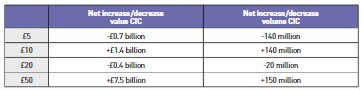 The net change in value and volume of cash in circulation by denomination.
Subscriber content
Read the full article
Full access to Cash & Payment News articles, newsletters and archives.