
The Practicalities of Partnership


Bantas is a Turkish based cash in transit (CIT) joint venture between three Turkish commercial banks. With about 1,600 staff, it looks after 48 cash centres, servicing 9,000 ATMs, 2,700 bank branches and 3,300 shops using 425 armoured trucks.
In 2019 Bantas presented on the realities of co-operative cash handling models in Georgia at the Europe Cash Cycle seminar (ICCOS). Since then, Belgium’s four largest banks (Belfius, BNP Paribas Fortis, ING and KBC) have formed Batopin, joining the long list of countries sharing cash infrastructure, and the world has started to adjust to changing levels of cash usage as a result of the pandemic.
Cash handling operations
There are four elements of cash handling: cash processing and management, security and support, ATM and self-service devices (SSDs) and CIT. Within each of these areas are multiple steps requiring skilled, experienced staff, sound processes and investment in equipment and information systems.
A McKinsey paper, ‘Attacking the Cost of Cash’, suggested that there are three areas where costs can be reduced across these areas:
Making cash operations in cash centres and bank branches lean (30% reduction), using cash forecasting tools (30%) and using advanced route optimisation tools (5-10%).
Ensuring bank-owned distribution networks, branch and ATMs, are the right size, appropriately sited and equipped.
Pooling resources with other banks to create a shared cash handling network. A shared ATM network could save 25-30% and further savings should be possible from shared counting facilities.
What activity is core to a bank?
Simply put, banks are financial intermediaries between savings and credits. The core function of a bank is the buying and selling of money and, therefore, everything else can be regarded as non-core, as secondary and so possible to be outsourced.
If cash handling is outsourced, it may also be possible to reduce costs based on greater economies of scale and eliminating inefficiencies. It also allows the bank to transfer risk outside and to allow it to direct all its focus to its core function.
What are the options?
One option is to keep cash handling in-house. The great advantage is that the bank retains absolute control of its operations. By focusing on improving, optimising and rationalising its work, it is estimated most banks could save 10-15% of their costs.
Alternatively, it could outsource cash handling, reducing costs by perhaps as much as 15-20% as well as transferring risk and allowing it to focus on banking.
Outsourcing brings with it challenges of control. Key questions to consider include whether there is sufficient provider choice? Can a provider be found who will give full coverage, whose service prices will be reasonable and whose quality can be assured? Is a long term partnership possible? Will a split provider to mitigate risk be possible?
The final option is to develop a multi-bank capability. Bantas estimates that savings of 20-30% should be possible based on sharing assets, functions and best practice. The more the number of partners, the lower the start up costs and operating costs per partner.
Bantas’s own experience is that in 2009, when it started, the cost per city drop was $40; by the end of 2018 it was $4.
Bantas was established in 2006 and it took five years to become a fully-fledged CIT provider. It took four years for a strong business case to be achieved after much testing and learning. In its first two years it only served its shareholders, thereafter it ‘commercialised’ the offer and served other organisations. Its growth rate of service points over 10 years has been 8.1%, whereas its growth of cash centres and armoured cars has only been 3.7%.
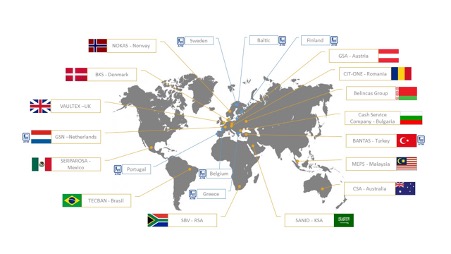
In 2013 Bantas was asked to help eight banks in Saudi Arabia set up a similar CIT and cash processing organisation for them, called SANID. The whole project took three years, effectively cloning Bantas. This business was intended to serve 60% of the Saudi market over 5,000 ATMs and 350 branches.
Challenges of the co-operative approach
It would be wrong to suggest that this approach is without challenges. Shareholder/client relationships require careful handling so that all are confident they are getting fair and equal treatment within the partnership.
It is important to have transparency about what is being done for whom, requiring accurate pricing and ensuring that costs are accurately and correctly allocated.
This goes with systems to handle complex reconciliation issues and the ability to demonstrate to shareholders, and non-shareholders, that the organisation is competitive and adhering to clear service terms and conditions. Advanced technology and automation along with comprehensive reporting and co-operation helps deliver this.
An intense focus on cost and quality and the ability to demonstrate the best quality/price ratio in the market removes sources of friction. An unexpected challenge is the need to balance off working on operational issues and delivering strategy and growth.
The future
This is a time when the number of bank branches is declining but also where self-service banking and the number of SSDs is increasing. Electronic ‘mini branches’ with ‘loaded’ SSDs are increasing. Serving this requires new skills and different approaches.
Since the ICCOS presentation, seven public banks in Turkey have decided to merge their ATM fleets, representing 40% of the country’s 53,000 ATMs.
In addition to Belgium’s Batopin initiative, three Romanian banks have formed Cit-One, expanding its role from serving one of them to all three.
Similar initiatives are underway in Pakistan, and the Banking Association of Georgia has also started the process of creating a joint CIT and cash processing capability for its members, and possibly in Ukraine as well, where Vaultex has recently been appointed to support the National Bank of Ukraine’s cash strategy.
It is clear that co-operative models are increasingly being adopted around the world, not just in Europe. This paper by Bantas demonstrates that it is possible to apply lessons learned in one region into another and that, when you get it right, a sustainable commercially led solution is possible.
Subscriber content
Read the full article
Full access to Cash & Payment News articles, newsletters and archives.