
ECB Emphasises the Importance of Cash

The European Central Bank (ECB) has published the results of a major study into the payment attitudes of consumers in the euro area (SPACE) and compared it with a similar 2016 study (the SUCH study on the payment attitudes of consumers in the euro area). It also published results of another large scale interim 2020 survey, the impact of the pandemic on cash trends (IMPACT) survey.
The reports give a mass of data about all types of payment. Cash remains the most used payment method but with evidence of changing usage, albeit the variation across Europe is very significant. The report is rich in information and this summary picks out just a few of its findings.
The SPACE survey, conducted between mid-March 2019 and midDecember 2019, consisted of 41,155 respondents in 17 euro area countries reporting their transactions in one-day payment diaries, along with payment diaries from Germany and the Netherlands in 2017 and 2019, which were included where possible in the analysis.
Change in cash usage
Across Europe, cash payments at the point-of-sale and person-toperson retail transactions fell in volume and value between 2016 and 2019, from 79% to 73% for volume and 54% to 48% for value.
The number of card payments for in-person retail payments increased from 19% to 24%, with contactless payments representing 40% of those payments.
Between 2016 and 2019 access to cash had declined slightly, from 94% to 89%. In a few countries the report said it can no longer be said that cash is universally accepted.
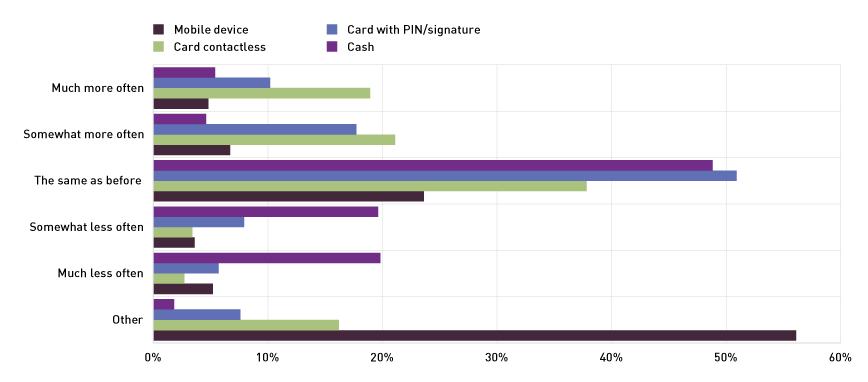
The IMPACT survey was carried out in July 2020 based on online surveys of 17,779 people. Four out of 10 respondents reported using cash less often since the pandemic started and 90% of those who said that expected to continue to do so from now on. The increase in the payment threshold was regarded as making contactless payments more convenient.
35% of those who paid using cash said they had experienced a situation where cash was not accepted.
Reasons for less cash usage
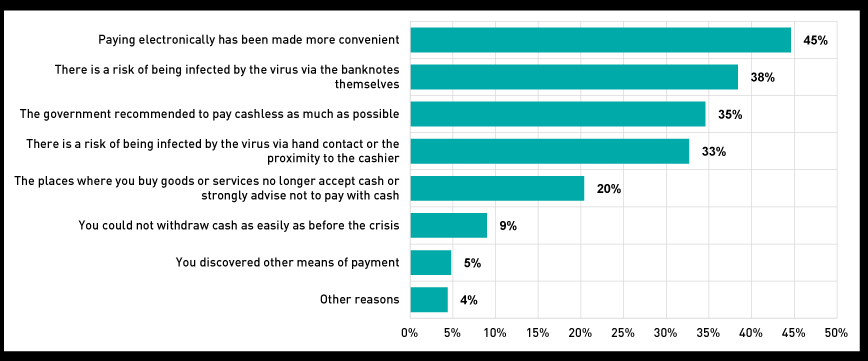
The survey explored why people used less cash. Although fear of infection rated highly, when asked about concerns about becoming infected while handling cash, 55% of the respondents were not concerned.
Payment behaviour
The study asked people about their payment preferences and these were then charted against the known use of cash in the countries.
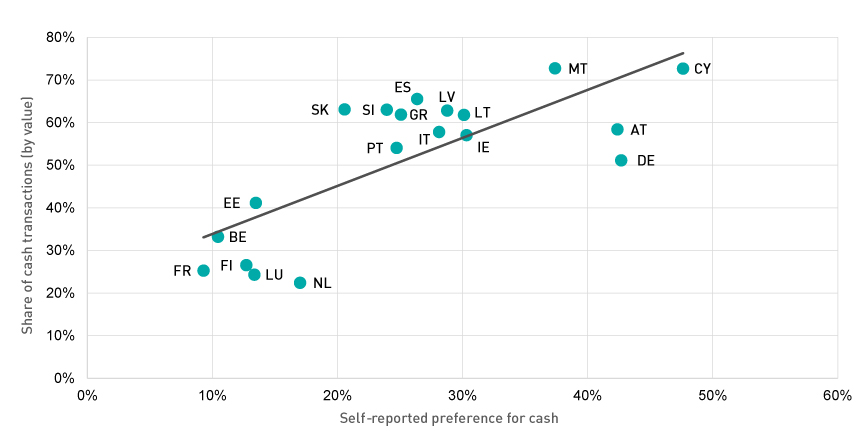
Cash was the payment instrument most used at the point of sale and for P2P transactions in 2019, even in countries where a large majority of respondents reported a preference for cards or other cashless payment instruments – thereby showing a low preference for cash. This shows that opinions and perceptions can deviate significantly from actual behaviour.
The chart shows that stated preference for cashless means of payment and actual payment behaviour differ at a country level, although a higher stated preference for cash is generally associated with a higher share of cash transactions in terms of value. Three clusters of countries can be seen, those with a low reported preference for cash (the share of cash transactions in value terms is relatively low, 20% to 36%), those close to the average (the share of cash transactions ranges from 53% to 65%), and those with a relatively high reported preference for cash, around 51% to 75%.
The importance of cash
55% of euro area citizens consider cash important or very important, even though it is not necessarily their most-preferred payment instrument. Having the choice appears to be important, even if they pay less with cash over time and generally have a preference for cashless means of payment.
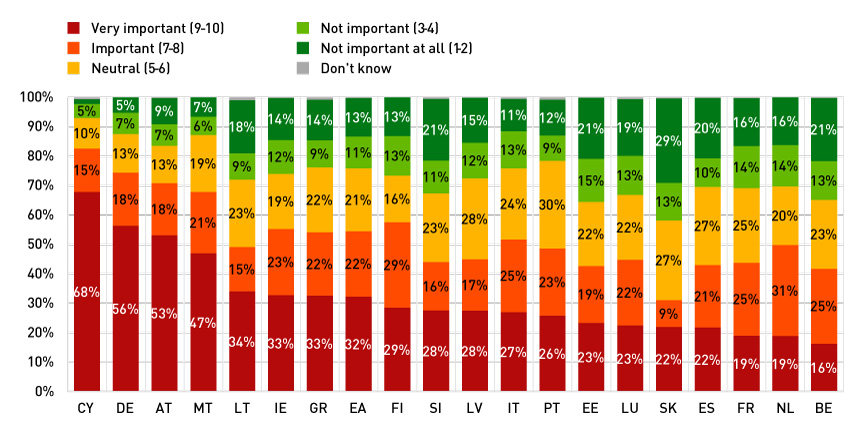
The same question was asked in the 2020 IMPACT survey. Although about the same number of people in both the SPACE and IMPACT studies regarded having the option to pay with cash as important or very important, there was a reduction in those categorising it as very important - from 32% to 23%, a nine-point reduction offset by a seven point increase in those regarding it as important, 22% increasing to 29%.
Access to cash
The only data collected was about the perception of access to cash through ATMs. Between the 2016 SUCH study and the 2019 SPACE study, a significant number of countries appear to regard ATM coverage as having deteriorated.
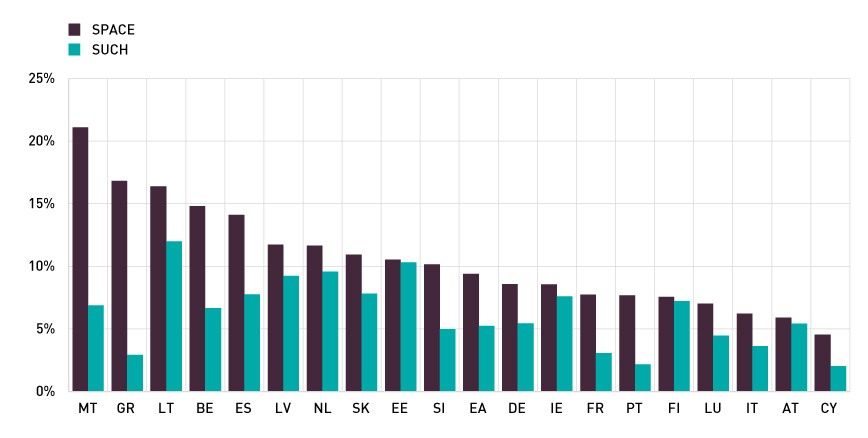
An unusual part of the survey looked at how people accessed cash. The value figure shows ATMs as being the prime source (58% of value), but in terms of the number of times cash is accessed, a different picture emerges. It gives a glimpse of cash payments, the role of P2P payments (9% of value) and how stored cash is used (10%). Cash in hand payments were 7% of value. The role of the bank branch (12% of value) and cashback (2% of value) as sources of cash are put in perspective.
ECB comment on the findings
Fabio Panetta, an ECB board member, commented on the importance of resilience in payments and the role of cash in supporting that. ‘It provides a crucial backstop and a trusted store of value.’
He went on to say that ‘consumers’ freedom to choose their payment method is of the utmost importance to us. Therefore, we aim to ensure acceptance of and access to cash throughout the euro area, while promoting innovation on digital payments, including in our work on the possible issuance of a digital euro’.
Subscriber content
Read the full article
Full access to Cash & Payment News articles, newsletters and archives.