
Snapshot of Asia in 2021


YouGov have issued their 2021 Global Banking and Finance Report, having surveyed 1,000 people in 17 countries representing a nationally representative sample with three exceptions. These were China, where sampling was ‘online representative’, India ‘nationally urban representative’ and Mexico, which was nationally representative but with an urban bias. Six Asian countries were involved – Australia, China, Hong Kong, India, Indonesia and Singapore.
The survey showed a clear shift away from cash in parts of Asia, although a skew in China and India’s sample set may be distorting the results.
One would expect other large countries in the region such as the Philippines, Malaysia, Thailand etc. to be closer to Indonesia than to Singapore in their preferences. The preference for contactless payments perhaps gives an indication of change but also of a possible lag between preference and infrastructure, hence India’s scoring.
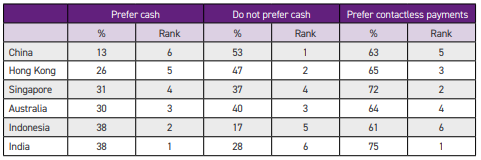
Attitude to cash and contactless payments
It was interesting to see Indians both preferring cash (only Germans and Mexicans like it more), and liking contactless payments (only Poland likes these more). Indonesia prefers cash at the same level but the rest of the region is not so keen. Australia’s score is higher than expected given how little cash it actually uses.
When it comes to disagreeing with the statement ‘I prefer to use cash’, the number of respondents in China and Hong Kong is high, with Australia and Singapore quite close behind.
China’s score is not unexpected, particularly for an online representative sample, but Hong Kong has a reputation for preferring cash which is not reflected here.
At the other end of the spectrum, India’s score is higher than expected, although the survey was skewed towards the urban population.
When it comes to a preference for contactless payments, and the statement ‘I use contactless payments wherever possible’, India’s result is unexpectedly high. Again, the urban skew needs to be considered. The Chinese score is perhaps lower than expected but this may represent confusion about whether people interpreted paying with an instrument such as WeChat Pay as being contactless. Similarly, for such a cashless society, one might have expected the Australian score to be higher.
Subscriber content
Read the full article
Full access to Cash & Payment News articles, newsletters and archives.