
Reducing Cash Impact on Climate Change
With the UK recently hosting the 26th UN Climate Change Conference of the Parties (COP26), companies in the UK cash cycle are thinking about what they can do to play their part.
NatWest issues Royal Bank of Scotland and Ulster Bank banknotes and is a Note Circulation Scheme member in England providing cash handling services throughout the UK. NatWest has played a leading role in getting the UK cash industry to work together to tackle the environmental impact of cash. NatWest are looking at their own processes and changes they can make to reduce their climate impact. Removing the plastic that is used when processing cash is one of these important changes.
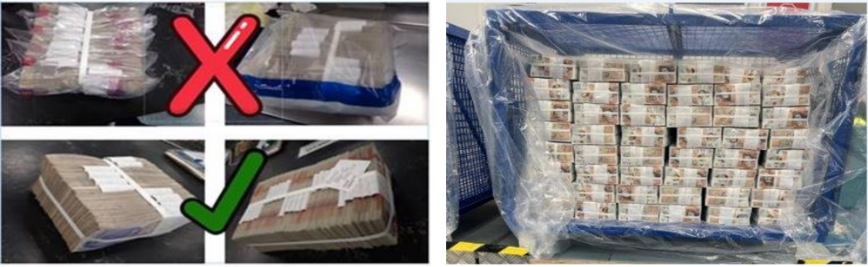
As part of the Cash Industry Environmental Charter commitment to eliminate single-use non-recyclable plastic in note centres by 2030, cash is now leaving NatWest’s Edinburgh Cash Centre without plastic wrapping. Since 6 September, Santander, G4S, Loomis and Tesco have been sending out bulk ATM cash from the NatWest Edinburgh Cash Centre, ‘un-sleeved’ and with no single use plastic wrapping.
Previously, when ATM cash was sent out in bulk to G4S and Loomis, all the notes were strapped into the Bank of England standard requirements and over wrapped with a single use plastic bag. On receipt of this, Loomis and G4S then had to break the cash down into the required volumes and denominations ordered for each stores’ cash machine. Staff at G4S and Loomis would then spend time removing the single use plastic overwrap bags from the cash before it could be loaded into each stores’ cash machine cassette.
This new approach at NatWest’s Edinburgh Cash Centre builds on the work at their English cash centres to remove their use of plastic overwrap bags. This joint venture removes around 140,000 plastic bags per year, which is enough plastic to cover the distance from NatWest’s London office at 250 Bishopsgate to the COP26 location in Glasgow.
While this change is feeding into NatWest’s climate commitments, it also has an important impact on cost and time savings, including:
Time savings at the Edinburgh machines, where operators don’t have to bag/sleeve up cash;
More time saved as carriers no longer need to remove plastic from the cash, on receipt, before replacing the cash in service till trays; and
Cost saving for carriers by not having to dispose of plastic waste and getting rid of 20 boxes of ‘overwrap bags’ per month.
This is just one of many transition projects NatWest has on the go as they drive forward their focus on decarbonisation.
Remote ATM maintenance
As part of the commitment to achieve net zero carbon for its own operations by 2030, NatWest are trialling remote fixes to ATMs in 16 of their hardest to reach branches in the Scottish Highlands and Isles.
To give an indication of the value of this change, one journey to the Lerwick branch (in the Shetland Isles) saves an engineer a 550 mile round trip. In just four months, this saved nearly 2,000 miles of journeys by car and ferry, reducing engineer visits by nearly 50% and removing over 0.5 tonnes of CO2. This benefits their customers too by reducing the repair time needed for an ATM to be back up and running. Over a whole year this could save up to 50 visits to these 16 sites and this is just the start, with plans to roll this out to some of NatWest’s busiest branches.
Richard Talbot, Head of Cash & Self Service Operations, NatWest Group said: ‘we know our customers continue to rely on cash and we want to ensure they can access the cash they need whilst reducing the impact this has on our climate. These projects are just a few examples of the important work we are doing.
‘Tackling climate change is a core part of our purpose and achieving this requires a culture shift in all our thinking, including encouraging our staff to suggest ideas to help in our transition to a lower carbon economy. We want our staff and customers to know every small change builds up to big outcomes and real impact to drive the change that is needed to meet our environmental commitments.’
A Case Study: Bringing Together an Industry on Sustainability
NatWest is committed to shaping and accelerating the UK’s cash cycle transition to a lower carbon economy. As part of this commitment in September 2020 NatWest brought together 36 organisations including UK Finance, the Bank of England, commercial banks, Retailers and ATM suppliers to discuss sustainability and the environmental impact of cash.
There was agreement that co-operation would help, although quite what or how to take this forward needed more work. This online meeting agreed to set up three working groups to consider options.
The result was proposals for cross industry working groups working on saving energy, reducing the use of single use non-recyclable plastic and CO2 emissions. In addition, a set of targets was agreed, and all this was put into a charter which included those targets. Organisations were asked to sign up to the charter by the end of January 2021.
Targets agreed
1. Achieve Net Zero for ‘Own Operations & Business Travel’ by 2030
2. Eliminate single-use non-recyclable plastic in note centres by 2030 (3yrs 25%, 5yrs 50% 10yrs 100%)
3. Reduce single-use non-recyclable plastic in coin centres to below 45% of plastic waste (by weight) by 2030 (3yrs <70%, 5yrs <60% 10yrs <45%)
4. 100% Renewable Electricity – Own Operations by 2022
The Charter in practice
The result is 12 organisations have signed and committed to the ‘Cash Industry Environmental Charter’ and its targets. Some organisations could not sign up because their larger parent organisations had already set targets that differed from those in the charter. Not signing the charter has not stopped all 36 organisations working together. UK Finance acts as the ‘secretariat’ for the group and G4S chair the regular online meetings following a set agenda reviewing the areas of work.
The organisations share metrics, projects and progress against the targets at each meeting. Where changes are to processes that reach across the industry, or which require a change in standards (or even regulations), this forum facilitates agreement because of the visibility of what is being looked at and the shared end objectives.
This initiative is one that could be replicated in any country. It requires an organisation to step up, as NatWest did, and create a coalition of the willing.
Subscriber content
Read the full article
Full access to Cash & Payment News articles, newsletters and archives.