
Book Review: Shades of Sovereignty

For the first time in two centuries, since the establishment of central banks began, the definition of money is being reviewed. A combination of quantitative easing, a response to the 2008-9 financial crisis which goes on today, the emergence of big tech companies with global reach to billions of people and the development of new cryptocurrencies, particularly those based on distributed ledger technology (DLT), means the certainties of physical fiat currencies and the established financial institutions and markets are under review. Change is in the air.
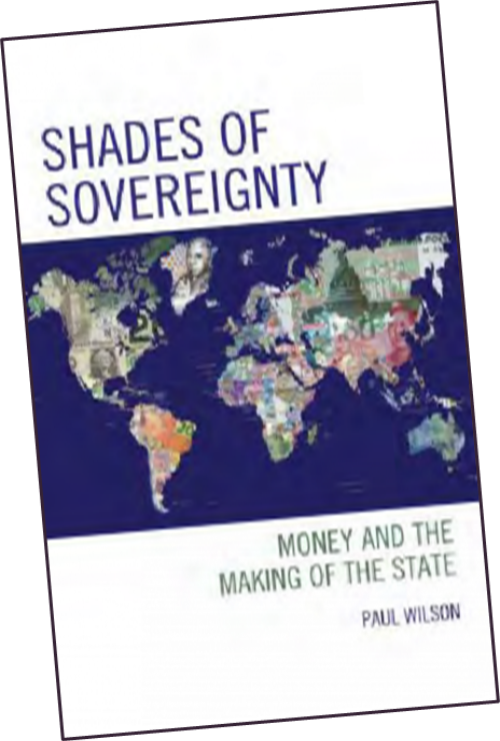
In that context Paul Wilson’s book – ‘Shades of Sovereignty: Money and the Making of the State’ – is a useful read. He looks at the role of money in the making of the state through the ages right up to the pandemic. He demonstrates that although money is a critical element in defining nationhood, the interaction of money, citizen and state has been incredibly fluid around the world and over time. It appears that there are fundamentals that have to be got right for money to work and where those are lacking, a range of approaches have been tried and have worked. As we work through the implications of cryptocurrencies such as bitcoin, stablecoins and central bank digital currencies, perhaps we should also look back at these examples.
After the second world war we saw Britain, France, Belgium and Portugal dissolve their empires. In the 1990s we saw the end of the Soviet Union and the disintegration of Yugoslavia. They mostly rushed to set up central banks and issue their own currencies, exceptions being, for example, the Franc zone unions of West and Central Africa and the Eastern Caribbean Central Bank.
We have seen currency unions with the Eurosystem being a prime example, but also the Multilateral Monetary Area of South Africa. The book also looks back to the short lived Latin Monetary Union 1866- 1920s and the Scandinavian Monetary Union 1875-1918. It makes the point that some countries enter currency unions to achieve goals other than economic ones, for example Estonia joined the euro partly as a means of ensuring its independence.
We have seen dollarisation and euroisation – for example Ecuador (2000), Timor-Leste (2000), Montenegro (2002 – the euro), Bosnia (2004 – the euro), Zimbabwe (2009) – as a response to the inability of those countries to be able to maintain a stable currency of their own.
The primary challenge through all of the stories recorded in the book is how to ensure stability in the value of the currency. Irrespective of whether the currency is based on a tangible object such as gold and/or silver, or linked in some way to another currency, citizens will seek out stable value. This book tracks the constant struggle of nations to do this, particularly where they lack scale, wealth or stability.
Given the rise of cryptocurrencies, this book challenges the link between money and sovereignty. Monetary independence is separate from having your own currency. Robert Mundell wrote in his 1997 paper ‘Money and the Sovereignty of the State’ that monetary sovereignty comes in three parts:
The right to determine what constitutes the unit of account – the commodity or token in which price lists are specified.
The right to determine the means of payment – legal tender for the purposes of discharging debt.
The right to produce money – or else determining the conditions under which it is produced by others.
It is not that a state must produce its own money, but that it can choose to do so if it wishes. There is a libertarian argument that private money should be allowed to circulate freely but that governments should resist the temptation to bail them out should they fail. Fear induced prudence being necessary. The consequences of failure and practicalities such as what currency must taxes be paid in cast doubt on this option, although cryptocurrencies mean these questions are more than theoretical.
The book draws to a close with the comment ‘currency is essentially a tool to support trade and maintain value earned. The acceptance of this simpler characterisation of money will liberate governments and central banks to adopt the monetary regime that best works for their countries, free of the mystique of nationalism.’
‘Shades of Sovereignty: Money and the Making of the State’ is published by Rowman and Littlefield – www. rowmaninternational.com – and can be bought at a discount using code ‘RLFANDF30’.
Subscriber content
Read the full article
Full access to Cash & Payment News articles, newsletters and archives.