
Cloud Money – Cash, Cards, Crypto and the War for our Wallets

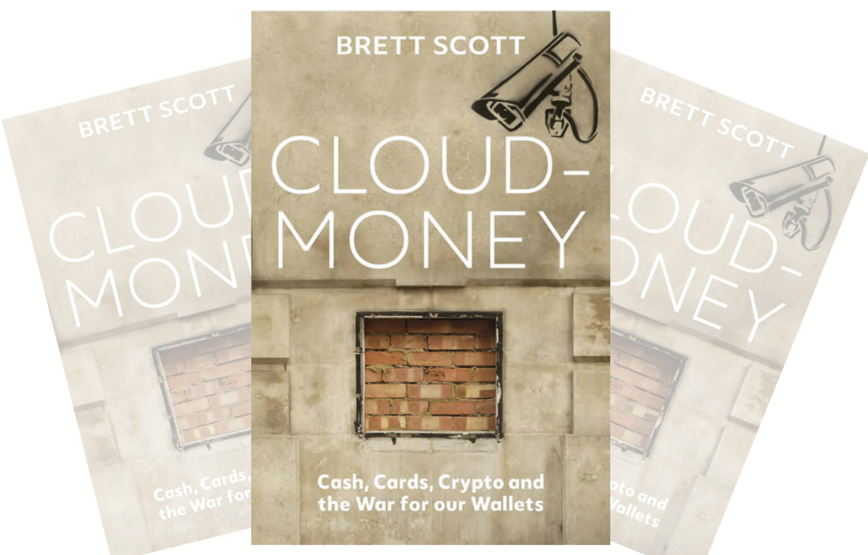
Brett Scott’s new book has just been published. It reads easily, flowing along at a great pace. The book lays out with wonderful clarity what money is, how every type of ‘money’ has become what it is from cash to central bank digital currencies (CBDC), with every variant in between, and how the financial system works and interconnects.
Cloud Money puts all this in the context of economics, technology, psychology and societies, describing the forces pushing the digital agenda and the implications of just living with what is happening. The author lays out the implications of the choice we are making, whether consciously or not.
Unsurprisingly, Brett suggests you buy ‘Cloud Money – Cash, Cards, Crypto and the War for our Wallets’ using cash in an independent book shop, but you can buy it online too! Its currently in English, German and Dutch but with other languages to follow.
If you are put off by the publicity for this book which tends to focus on the ‘sensational’, that the book is revealing how big finance and big tech are working together to squeeze out cash because it is a roadblock to capitalist growth, don’t be. In fact, as Brett lays out right at the beginning, his goal is to fill in the shadows of the narrative of the digital enthusiasts, to act as a contrast to rebalance them. He recognises and is not unsympathetic to ‘the deeply contradictory nature of our lives in a global capitalist system, where innovations can be simultaneously empowering and destructive.’
Types of money
The book explains what it terms as tier one money (cash), tier two money (commercial bank digital money) and tier three money (the work of the likes of PayPal and Venmo). Each tier builds on the tier below. The role of the central bank lies at the heart of all this as the issuer of tier one money and its role supervising the work of the financial institutions and now, the technology companies as well. The importance, influence and control of central banks overseeing the financial system is a constant theme.
A key concept is tier two digital tokens created by commercial banks that represent tier one money. Because they all have the same unit of account and are exchanged at par both with tier one money and with each other, the reality that in fact an HSBC bank account holds HSBC tokens and a Barclays Bank account holds Barclays tokens is not visible to the account holder.
The need for a settlement system between the banks, managed by the central bank, is not always understood by the public. The implications of banks failing are mitigated by the lender of last resort role of the central bank and, perhaps more immediately important, the deposit guarantee offered by most central banks up to given limits on accounts. All this comes with regulation and supervision.
Once the ‘basics’ of defining what is money and how the financial system works is explained, and it is clearly and beautifully articulated, the book goes on to look at today’s trends and why cash is being put under so much pressure.
It explains how capitalism needs growth to work and that digital money allows financial institutions to control people’s behaviour and expenditure. At the same time it explains how technology companies need payment data to drive their own business success. This coming together of mutual interests has led to the changes we are experiencing today.
War on cash
‘Equivocation fallacy’ is where the same term is given to two different things. For example, ‘cashless’ is used in connection with ‘cashless society’ and also ‘cashless payment’. Identical names for two different things can lead to the separate meanings polluting each other.
For example, the French government calls its bank digital payment plan the ‘cashless payment plan’; however it is entirely possible to for cash and digital bank tokens to co-exist. To call digital bank tokens ‘cashless payments’ means that the end of cash is implied.
The equivocation fallacy is just one example explained in the book of a whole range of activities that has led to the psychological ascendancy of digital money.
Crypto, stablecoins and CBDCs
Cryptocurrencies are the digital equivalent of engraving the number ‘1’ on a flattened bottle top and saying it is a currency.
Because the number is not a ‘liability’ on an organisation or linked to an asset, it is just a number. Effectively these numbers are a limited edition ‘collectable’ with a monetary price. Except if counter-traded, the whole logic underpinning cryptocurrencies means they cannot be categorised as money.
Stablecoins are described as another form of tier three money. In the same way PayPal takes your bank tokens and issues you with PayPal tokens, the money in your PayPal account is a promise to repay you in bank tokens, hence being third tier.
Stablecoins are third tier tokens recorded on a blockchain network. A Tether token, therefore, is ‘crypto dollar’ backed by bank dollars, partially backed by the state dollars of the Federal Reserve.
CBDCs can be seen as a response to central bank concerns about a hyper-digitalised money system. If cash were to disappear, people would be at risk because the commercial banking sector is motivated by profit and cannot, therefore, be trusted to serve less profitable members of society. CBDCs would suffer the same privacy issues as the other digital payment options.
Traditionally central banks issue resilient, inclusive and offline public cash that is private. Commercial banks provide private digital money where the data is used commercially. The physical nature of cash limits its usefulness for high value criminal activity. However well designed, a CBDC risks giving criminals the best of both worlds.
Last word
The book ends by arguing we need to assert vigorously our right to use cash. This is not a refusal to move forward with the times but a conscious and deliberate celebration of a different set of priorities. Not capitalism first, not efficiency first, not technology first. Cash is ‘the right to be dirty and physical’, to be ‘messy and contradictory’. Cash is money that belongs to everybody that links people and organisations. Cash is capitalist but it is also part of and a reflection of being human.
This book explains money and the financial system clearly and simply. It argues persuasively that paying with cash is a necessity and a joy, not an enforced choice that would be better ended.
Subscriber content
Read the full article
Full access to Cash & Payment News articles, newsletters and archives.