
When is Money Real? When It Hurts to Spent It

The Dutch National Bank (DNB) has issued a working paper considering the implications of moving to non-cash payment methods, if any 1.
The concept of the ‘pain of paying’, the negative emotions people experience while paying for goods and services, is well known. Electronic payments appear to inflict less pain than paying with cash, and the DNB’s concern is that over-spending is more likely as the Dutch public move swiftly away from cash.
As a result, it has carried out a large-scale detailed consumer survey to understand what is happening.
Key findings
Electronic payments hurt less than cash payments whether off- or on-line, especially for contactless payments and the
Netherland’s iDEAL payment method that is largely used for online payments. It also appears that older people feel less pain paying than teenagers.
A positive correlation was found between the pain experienced and the price of a good or service. If a fun trip was being purchased rather than something mundane like groceries, less pain was felt. Different categories of people experienced more pain when paying – women, the highly educated, single people, those who struggle to make ends meet, those who are excessively frugal, people who frequently check their account balances and those with a low level of financial literacy.
Finally, cash was perceived as the most helpful way to stop over- spending.
The study
A discreet choice experiment was carried out with a representative sample of the population. The survey set up hypothetical situations with different payment instruments, types of expenditure and amounts paid. It used information on personal characteristics to research how pain differed between people.
58% of respondents categorised themselves as middle of the road when it came to how freely they spend money. 24% described themselves as excessively frugal (tightwads) and 18% as spendthrift. 8% found it hard to make ends meet and 56% found it easy or very easy.
The literature suggests that if payment is fast there is less pain and people spend more, and that electronic payments hurt less than cash payments.
The pain of paying is positively related to the transparency of the payment instrument, and cash is more transparent than electronic payments. Each payment method has steps required to complete the transaction, with cash having the most and a mobile payment the least. Cash payments are both physical and visible while card payments are digital and invisible.
Previous research has shown that the willingness to pay when using a debit card is 22% – 54% more than when paying using cash. A US study found that the spending ratio at the point of sale increased by 10% for debit cards and 8% for credit cards compared with cash.
When the price is high, using the right payment method matters more. Also, good financial knowledge reduces the extent to which mobile payments exacerbate over-spending.
How do the Dutch want to pay?
57% preferred to pay using a contactless debit card.
17% using a traditional debit card.
11% using a contactless mobile phone (linked to a card).
14% using cash.
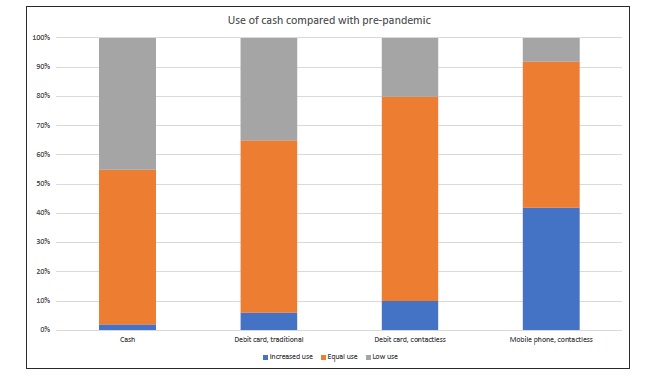
Only 10% of people never paid using a contactless method and over 70% had made over their half of their monthly payments using a contactless method. During the pandemic contactless payments using a debit card were the big beneficiary gaining ground on other payment methods.
Pain of paying
People who were under 20 years old did not experience more pain paying with cash but did when paying with a debit card, 0.7 times more. The explanation for this is that for younger people who have grown up with digital payments, cash is not ‘real’. Once withdrawn it is, effectively, spent, the bank balance is less, and cash is seen as a token. 20-29 year olds experienced little or no pain paying using a credit card.
Perhaps unsurprisingly given their stage in life, older people looked forward to fun trips more than younger people. On the other hand, an 80 year old only experienced 1.1 times more pain paying for something costing €500 compared with €5. For 20-29 year olds this was 2.1 times more. Women experienced 1.8 times more pain paying for something costing €500 compared with €5 but men experienced a third less than women.
Preventing over-spending
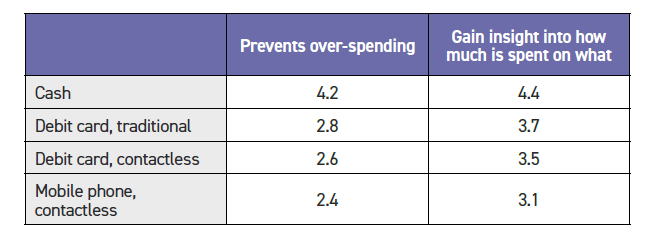
The helpfulness of payment instruments to prevent over-spending and to gain insights into how much is spent on what is measured on a scale of 1 ‘does not help at all’ to 7 ‘helps very well’.
72% of people used mobile phone apps to check their balances, 38% used the web and 11% used paper, amongst those 65 and older, this figure was 20%.
On this issue, and the concluding remark of the report, is that the key to increasing digital spending is to help those who struggle with managing their spending to do so.
1 - ‘Paying in a blink of an eye: it hurts less, but you spend more.’ Working Paper No. 760. Marie-Claire Broekhoff, Carin van der Cruijsen.
Subscriber content
Read the full article
Full access to Cash & Payment News articles, newsletters and archives.