
Australian Cash Update – the Journey Continues


In the July edition of Cash and Payments News Paul Blond, Managing Partner of The Blond Group, wrote about the initial impact of COVID-19 in Australia and how not only cash, but all payment methods took a tumble as the widespread lockdown of the country impacted the economy. With the Reserve Bank of Australia (RBA) publishing its latest data, Paul has taken a look at the numbers.
Cash up and down!
The dual role of currency both as a store of wealth and means of payment has never been more apparent, as the numbers that report cash on issue and cash use remain dramatically different.
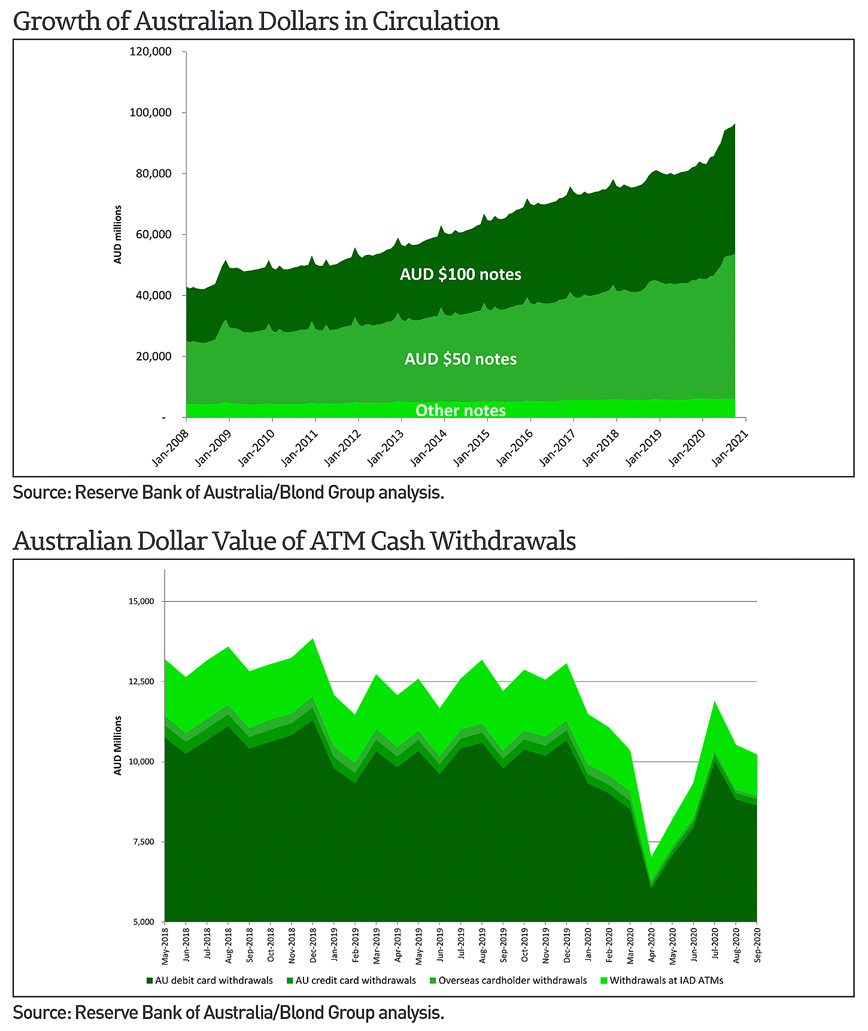
Cash on issue – perhaps a better term than cash in circulation, as clearly large volumes of cash are being held and not circulated – continues to break month on month records, with the numbers hitting almost $99.5 billion at the end of October 2020, up $17 billion (21%) on a year earlier. However, despite the records levels of banknotes on issue, reported ATM cash withdrawals remain substantially lower than this time last year.
Following a dramatic 37% fall in ATM withdrawals at the onset of the pandemic, a steady recovery was evident from May to July. Values recovered to just under 6% of the previous year figures, consistent with the pre-COVID-19 long-term decline in cash demand.
In early August Victoria entered its second wave lockdown, declaring a night-time curfew and severely limited movement outside the home. Unsurprisingly, with the state accounting for around 20% of the country’s ATMs and economic activity, withdrawals took another dive.
Impact of fewer ATMs
Consumers are also less likely to use their own bank ATMs. The reduced ‘brand loyalty’ is in part a function of the overall decline in the number of ATMs. The regulator APRA (Australian Prudential Regulation Authority) recently reported that the number of bank owned ATMs fell from 11,249 in June 2017 to 7,104 in June 2020. While some of the decline in machines can be attributed to transfers of bank owned ATMs to Independent ATM Deployers (IADs), total Australian ATM numbers have seen a significant contraction in recent years.
Cash Out and Cash Advance demand reduced
In Australia debit card cash out (or cashback), together with credit card cash advances, have formed an important alternative source of cash, typically representing about 12.5% of total cash withdrawals. By September, this has fallen to just under 10% ($712million in cash out, $418million in cash advances). Less point of sale activity and, in many cases, active discouragement of handling cash at the point of sale, will have accounted for much of this reduction.
Are ATM cash withdrawals for the hard-core cash user, whereas cash out at point of sale is a more discretionary transaction? With the United Kingdom considering legislation to mandate offering cash out as an alternative means of access to cash, is this channel really a robust and reliable source of cash supply, or an illusion to deflect from the decline in bricks and mortar bank branches and ATM networks?
Other payment methods also impacted
It's worth reflecting that while cash use at point of sale (POS) is down, Victorian COVID-19 restrictions have had an impact on all POS transaction activity. Both increased on line (including in app payments such as food ordering and ride sharing) and the popularity of buy now pay later (BNPL) schemes, such as Afterpay and Zip, are all influencing traditional POS activity.
A striking theme of the COVID-19 pandemic in Australia has been the pay down of credit card balances. In February 2020 outstanding credit card balances totalled $49.7 billion by September this has been reduced to around $38 billion, a 21% drop. There has been a recent increase in credit card use. Is this a sign of confidence and recovery of the economy, or quite the opposite and the start of a returned reliance on credit?
Looking ahead
The oft-cited disclaimer ‘past performance is not a reliable indicator of future performance’ is probably never truer at the moment as the effects of COVID-19, both in terms of health and economic impact, play out in Australia and around the world.
As in most aspects of life and commerce, COVID-19 has caused widespread shock and we are just beginning to come to terms with how this will shape the future.
Subscriber content
Read the full article
Full access to Cash & Payment News articles, newsletters and archives.