
Country Cash Profile: Mexico

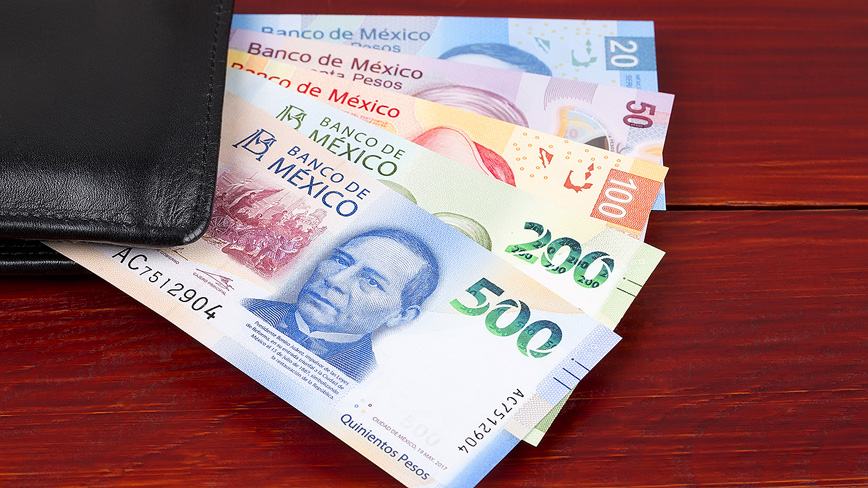
This is the latest in our periodic series of country cash profiles, focusing on México, host to the 2021 HSP Latin America conference. It has been prepared with the assistance of the Bank of Mexico, which has built a new print works, is in the process of issuing a new family of notes, and is one of the world’s leading central bank when it comes to cash management.
Economy
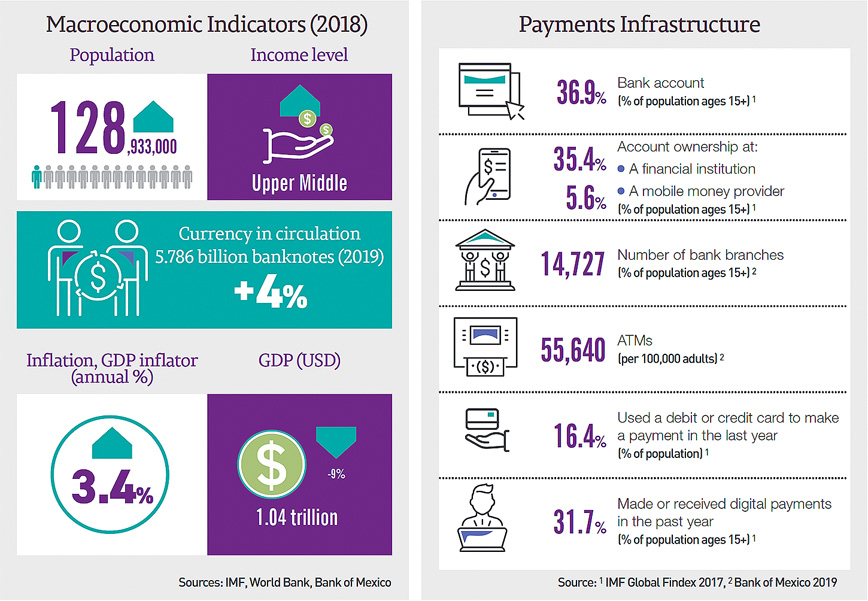
Mexico’s economy is amongst the top 15 in the world and it is the 12th largest exporter. With a population of nearly 130 million people, Mexico has the second largest economy in Latin America. On 1 July 2020 the United States Mexico Canada Agreement became effective, replacing the previous North American Free Trade Agreement.
The World Bank describes Mexico as being ‘upper middle income’ with strong macro-economic institutions and abundant natural resources, oil being a significant part of the economy. The US is Mexico’s main trading partner and GDP growth, prior to the pandemic, was averaging 2.2% per annum.
Services represent about 62.5% of GDP, industry 24.1% and agriculture 13.4%.
Currency
The Mexican currency is the peso and the symbol $ is used to represent the monetary unit within the country. Based on a decimal system, the peso is subdivided into one hundred parts, each called a centavo and represented by the symbol ¢.
The denomination structure includes coins of 5, 10, 20, and 50 centavos and 1, 2, 5, 10, and 20 pesos, and banknotes of 20, 50, 100, 200, 500 and 1,000 pesos.
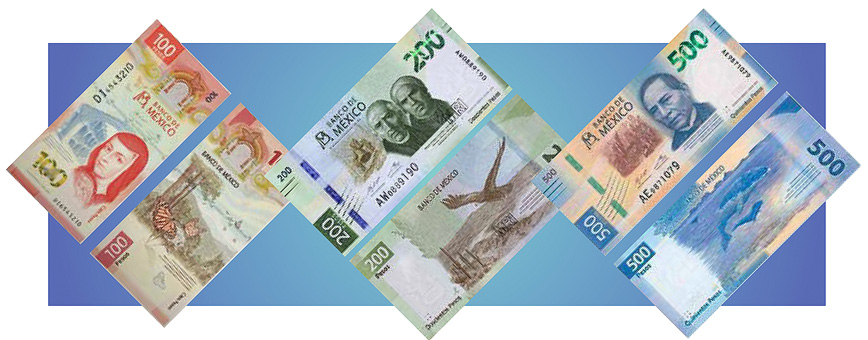
Currently, Banco de México is gradually putting into circulation a new banknote family, called ‘G’, replacing those banknotes belonging to family ‘F’. The new banknote family has improvements in security features, durability and functionality, as well as features for the blind and visually impaired.
F-type banknotes entered into circulation between November 2006 and August 2010, and consist of six denominations: 20, 50, 100, 200, 500, and 1,000 pesos. This family also includes single issue notes – the 100 peso polymer note commemorating the 100th anniversary of the Mexican Revolution, the 200 peso paper banknote commemorating the bicentennial of the beginning of Mexico’s War of Independence, and another 100 peso banknote commemorating the 100th anniversary of the Enactment of the 1917 Mexican Constitution. These notes are legal tender and do not replace the common 100 and 200 peso banknotes.
F-type banknotes have different security features, colours, and lengths. The latter are designed, along with the addition of intaglio and embossed features perceptible by touch, to help the blind and visually impaired identity the different denominations. The lowest denomination (20 pesos) is the smallest and measures 120mm while the highest (1,000 pesos) is the longest and measures 155mm. There is a 7mm difference between each denomination.
The 20, 50, and commemorative 100 peso banknotes are printed on polymer, and the rest on cotton paper. The polymer versions of the 20 and 50 pesos were introduced in 2002 and 2006 respectively.
New family
The new banknote family (‘G’) consists of six denominations: 50, 100, 200, 500, 1,000, and 2,000 pesos, but the latter will only be issued if and when it is required to meet the needs of users.
The 20 peso banknote of the F series is being replaced by a 20 peso coin, but the Bank is planning a new commemorative 20 peso polymer note to mark the bicentennial of the establishment of Mexico’s independence.
The 50 and 100 peso banknotes are printed on polymer, and the rest on cotton paper.
The themed images represented in these designs refer to the historical processes that have defined Mexico and, for the first time, include the natural wealth distributed throughout the country. On the front of each denomination, the following historical processes appear – Ancient Mexico, Colonial Mexico, Mexico’s War of Independence, Reform Process and the Restoration of the Republic, the Mexican Revolution and Contemporary Mexico (20th century). The country’s most representative ecosystems, rivers and lakes, temperate and dry forests, grasslands and desserts, coastland, seas and islands and wet tropical forests are depicted on the reverse, with images of recognised sites designated as UNESCO Mankind Heritage alongside fauna and flora typical of each ecosystem.
The G-type banknotes are 65mm wide and, as with the F notes, their length increases by 7mm from one consecutive denomination to the next. In addition, they have intaglio and embossed features perceptible by touch, albeit different from those used in F-type banknotes.
The 500 peso banknote, the first of this banknote family to be issued, entered into circulation in August 2018, and the 200 peso was put into circulation in September 2019. The 100 and 1,000 peso are issued this month (November 2020).
As different denominations of the two banknotes families are going to be in circulation for some time, Banco de México has designed a new clipboard that helps the blind and visually impaired to identify F- and G-type denominations. The first clipboard design was unveiled in 2012, but it is useful only for F-type banknotes. Distribution of the new one began in September 2019. The clipboard is made of plastic and enables notes to be identified by their length and the use of Braille characters. It is free of charge.
Coins
Coins are manufactured by the Casa de Moneda México, which reports to the Ministry of Finance. The five person board of the Casa includes two representatives from the Bank of Mexico. New coins are stored at the mint before being moved to one of the Bank’s six branches. From there coins are distributed to 80 private vaults or distribution centres.
Regarding coins, the 20 peso coin has traditionally been used to commemorate different events, such as the New Millennium, the 20th anniversary of Octavio Paz receiving the Nobel Prize in Literature, the 100 years of Mexico’s Armed Forces, and the 100th anniversary of the Enactment of the 1917 Mexican Constitution, among others. Thus, there are several different 20 peso coins designs in circulation.
In April 2020, a 20 peso coin with 12 sides was put into circulation. This coin celebrates the 500 years of the Founding of the City and Port of Veracruz. For the first time, a security feature – the so-called latent image – is included in Mexican coins. It consists of an image which includes a number 20 that can only be seen depending on the coin position. From now on, the Bank will promote the next 20 peso coin designs as having 12 sides and a latent image. It is important to mention that the coin sizes and edges are the main characteristics that help identify their denomination to blind and visually impaired people.
In 2019 there were 308 coins in circulation per person. At the 2017 Coin Conference, the Bank presented on its challenge to address the 64% of coins that it categorizes as ‘stagnant’ rather than ‘active’, including a major communication programme, charging commercial banks for the transportation costs of coins to cities in which banks did not have their own branches and running a self-service coin exchange pilot at a branch of Walmart in Mexico City.
At the 2019 Coin Conference, the Bank of Mexico spoke about the impact of coin demand unexpectedly increasing in 2015 just as it had cut its inventory levels. The result was coin shortages and inefficiencies in manufacturing, storing and supplying coins over the next few years.
An investigation showed that the introduction of electronic invoicing and auditing led to an increased use of cash with respect to credit and debit card payments, that an increase in banknote demand caused an increase in coins in circulation and that if there had been good, timely data about stocks of coins throughout the cash cycle, it would have been possible to avoid the significant over ordering that occurred by the commercial banks and the building of ‘defensive levels of inventory’.
Banknote production
Banco de México was founded in 2017, became sole issuer of banknotes from 1925 and in 1969 opened its Legaria printing works in Mexico City.
In 2011 it started planning a second printing works which opened in 2018 in Guadalajara, the capital of Jalisco State. Guadalajara was chosen because it is conveniently placed as a distribution point and the city already has one of the Bank’s regional offices. The print works, built on a greenfield site along with a cash centre and a shared vault, has one line of equipment and room for another. It is designed to print 600 million notes a year to produce 30-35% of the annual requirement. The new vault can store 5,500 containers and increases vault capacity by 40%.
Mexico has three banknote printing lines on two sites working on a two shift basis and capable of producing 1.75 billion banknotes a year. Both printing works can print polymer and cotton banknotes. There are 271 staff in Mexico City and 141 in Guadalajara.
Cash management
The aim of Banco de México is to provide the country's economy with national currency. To this end, Banco de México distributes banknotes through its primary and secondary networks.
The primary network comprises six Regional Cashiers located throughout the country, and the secondary network of 44 correspondent banks, which are banking facilities located at cities where there are no Regional Cashiers. The two major Regional Cashiers are located in the same cities where the two Banco de México's printing facilities are (ie. Mexico City and Guadalajara). These are responsible for distributing notes to the rest of the Regional Cashiers and correspondent banks1, which in turn are used to meet the demand of local banks, who make withdrawals in the denominations they require to meet their customers’ needs through bank branches and ATMs.
A banking institution’s fundamental obligation is to deliver fit banknotes in all transactions made in cash. In order to encourage them to do so, Banco de México has a regulatory framework for a banknote fitness classification process based on on-site supervision programs, which includes penalties in the event of infringements.
At the same time, banking institution channels enable everyone to exchange unfit banknotes free, as well as coins. The service consists of exchanging unfit notes or coins (damaged, demonetised, in the process of being withdrawn from circulation or deformed notes) for an equivalent amount in fit notes or coins; evaluating incomplete or marked notes, and their exchange for fit notes so that the public receive back their value, and exchanging domestic fit notes or coins for others of different denominations.
In total, financial institutions have 14,727 bank branches located across the country, of which over half (56% or 8,221 bank branches) provide a banknote and coin exchange service.
Regarding ATMs, financial institutions have approximately 59,608 of these located nationwide, of which more than half (60% or 35,632) dispense low denomination banknotes, ie. 20 and mainly 50 peso notes. This proportion is relevant because, according to the fourth quarter 2019 currency issues survey, 44% of the population (19.5 million people) indicated that their favorite banknote denomination with which to make cash payments is the 50 pesos.
CoDi
Banco de México has taken action to allow people who do not have a bank account to pay digitally. Less than 40 million Mexicans have a bank account with reasons such as being too far from bank branches, the cost of opening and owning an account, a lack of trust in the banking system and a wish to remain anonymous to limit tax payments cited as factors behind so many not having an account.
In an attempt to address this, the Bank has introduced Cobro Digital, known as CoDi, a mobile electronic transfer system to allow people to use their mobile phones to make person-to-person payments, payments in store and online payments using QR codes. There are about 80 million smart phones in Mexico. CoDi is free to use but does require a mobile phone and an account at a financial institution which is part of the interbank payment system.
At launch in September 2019, Mexico’s 32 largest financial institutions signed up to be part of CoDi. A year after its launch, 5.8 million people have registered accounts for CoDi, but the number of accounts that have actually been used is much smaller: 279,407 have been used for at least one payment transaction and 235,026 for at least one charge transaction. By the end of the year, the system is likely to achieve 1 million transactions (currently it is around 897,000), much less than the system’s capacity.
Cash is still the most popular means of payment among the population in Mexico, since, according to the Banco de México’s national quarterly survey of currency issues, more than 95% of the target population usually use cash in their daily expenses2.
1Correspondent banks are allowed, on behalf of Banco de México, to meet the requests of banknote deposit and withdrawal from other banks in their localities.
2The target population of the survey is people between 18 and 79 years old of both sexes and belonging to different socioeconomic levels, who live in localities of 50,000 inhabitants or more. In 2019, this population was approximately 44.1million people.
Cash in the Pandemic
The Mexican public turned to cash as the pandemic started and have largely stayed with it.
Between March and August 2020 demand for notes and coins went up 18%, significantly more than in the same period in 2019, peaking at 22.5% more in September before falling back. The requirement was largely for the 200 and 500 peso notes, presumably for hoarding purposes given the reduction in transactions and business in the economy. The government’s economic relief package for retailers and the in-advance payments of federal government transfers for social programmes related to scholarships, pensions and the disabled will have contributed to this demand. There was no impact on coin demand.
During the pandemic the number of operational ATMs fell by 0.7% and bank branches by 8.6%, not enough to affect access to banknotes. In Mexico it is embodied in the Monetary Law that business must accept cash. The Bank had to write to a number of companies to remind them of the law and this ensured that Mexico has not experienced the problem of stores not accepting banknotes.
From 30 March, the Bank of Mexico reduced its service to its 44 correspondent banks to two days a week. Today one correspondent bank gives service to its customers five days a week, 34 banks four days a week, five three days a week and four two days a week. Normality is steadily returning.
Subscriber content
Read the full article
Full access to Cash & Payment News articles, newsletters and archives.