
It’s All About Trust

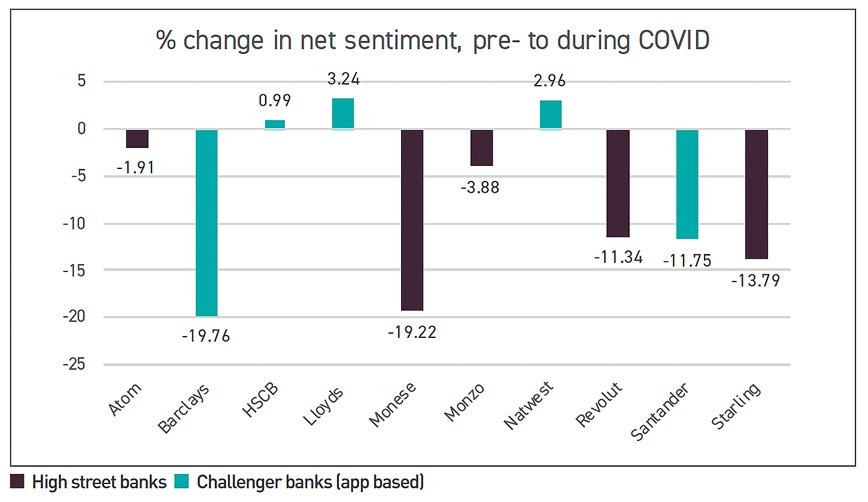
Chris Skinner recently wrote in his blog, www.thefinanser.com, about the future role of bank branches. His story was based on two Brandseye surveys of consumer sentiment in the UK about banks, one pre-COVID and the other, more recently, ‘during’ COVID.
The traditional banks are shown in orange and the new ‘challenger’ banks that do not have bank branches, in blue.
Pre-COVID four of the five challenger banks had a positive score. The chart shows a rather different view with a number of the traditional banks recovering ground. This is hard to understand when you consider that branches have been closed or had reduced opening hours. The traditional roles of bank branches – transactions, service, advice and as business centres – have ceased, reduced or fundamentally changed.
Chris’s article goes on to quote the CEO of CheBanca! In Italy, Roberto Ferrari, who argued that banks don’t need branches but customers do. Customers need to be confident that where they place their money is real, that the psychological, emotional ‘contract’ that they have with their banks is based on something tangible. A bank branch is, therefore, a ‘centre of trust’.
Our industry should steal this concept from Chris Skinner with pride, because the concept of money is built on banknotes and coins. Psychologically, money is held in those bank branches, and the whole banking and financial system is built on it. Few members of the public understand the concepts of public money, central bank money and private money, discussed in the review of the World Economic Forum’s Central Bank Digital Currency (CBDC) report in this edition.
Although people are comfortable with their bank accounts being accessed through cards and digital wallets, take away physical cash and this lack of understanding will matter. Where will confidence come from if there is a crisis or if systems fail? How do central banks design CBDCs if they are the only money of last resort? When people consider digital money, ultimately the benchmark is always cash, and that is all about trust.
A final word about trust, at a practical level. There is much talk and focus on cashback and post office systems as important future infrastructure for the public to get cash as ATM networks and branches decline. Privacy is part of trust. For many people the ATM and the bank branch teller represent anonymity. Their cash withdrawals are private. If you get cash from a post office clerk or somebody in a shop, that withdrawal is not private, or protected in the same way as ‘banking privacy’. This matters. In countries with established infrastructure, perhaps maintaining a comprehensive ATM network is necessary if cash is to continue to be trusted and used widely.
Subscriber content
Read the full article
Full access to Cash & Payment News articles, newsletters and archives.