
How did Americans Spend During the Pandemic?

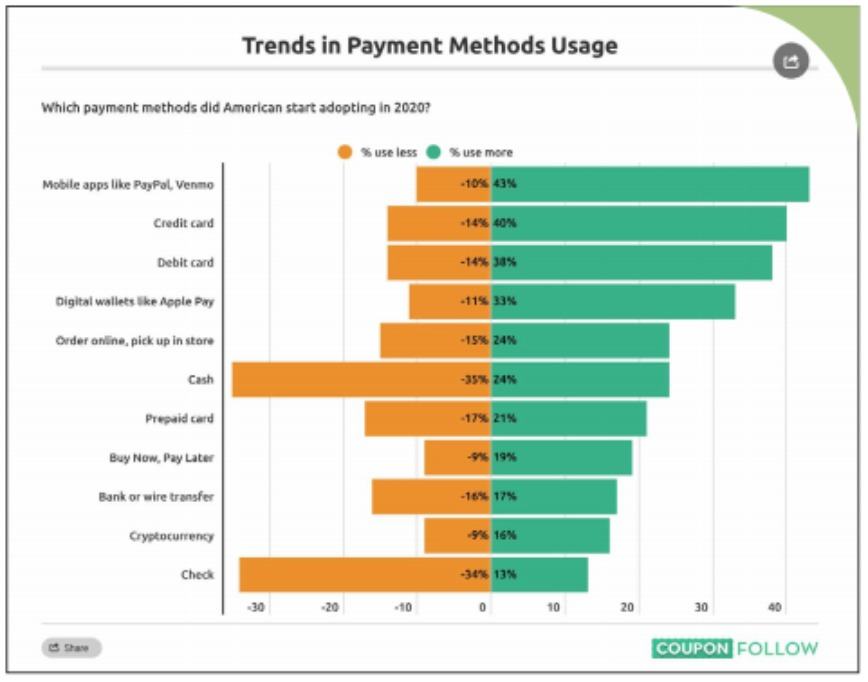
In 2020 US consumers each spent $17,095 according to the US census bureau, $2,398 of which was online. CouponFollow surveyed 1,500 Americans in January 2021 about the state of cashless and touchless payment methods during the pandemic.
It appears that, as in other countries, payment behaviour changed, with people trying cashless payments for the first time (41%) and concerns about COVID being important in that decision (49%). Despite that, 62% of Americans stuck to what they know, cash, and continued to carry it at any given time (92%). The vast majority continue to keep cash at home (88%).
As part of their experiments with contactless payments, the move to phone-based payments was significant. 42% started using apps such as Venmo and PayPal and 32% used wallets such as Apple Pay. Men and the Zoom and Millennial generations are leading the charge to adopt phone-based payments. Users do have reservations, with 44% seeing contactless payments as a fraud risk, 30% seeing them as unreliable and 27% finding them too slow. Despite that, 57% believe shops and retailers should accept contactless payments, giving the need to slow the spread of COVID as their reason.
Moving away from payments, the survey also asked about cryptocurrencies. Perhaps unsurprisingly, 40% said they knew nothing about them while 37% said they were just a passing fad. 38% though, regarded them as the future of money.
As with most advanced economies, most Americans use debit or credit cards to pay. In-person debit cards are preferred, although online it is credit cards. The research said that 28% of shoppers had more than $1,000 in credit card balances. As a result, credit cards are often associated with debt.
When it comes to carrying cash, men carry $111 compared with women’s $62 and it is, again Millennials and Gen Z that hoard cash. Cash was carried predominantly against emergencies (67%), but also for tipping (45%) and habit (40%). Debt control was 24% and because shops tend only to accept cash, 22%. Privacy and security reasons were important for 19%.
More generally, Americans do see cash as safe from fraud (65%), 49% regard it helps them stay out of debt and 44% find it convenient. This may have contributed to only 32% seeing themselves as giving up on cash.
Subscriber content
Read the full article
Full access to Cash & Payment News articles, newsletters and archives.