
Top Payment Trends in Turkey in 2021


Alper Sayin, Director Cash Planning and Operations at Garanti BBVA, has summarised the key cash and payment trends facing Turkey in 2021. Cash is increasing but cost control remains high on the agenda, with new cash processing tools being used and an ATM pooling initiative being closely monitored.
As in many countries, digital payments have been growing fast and the infrastructure for fast payments is now in place. Banks are starting to look at and work with blockchain and cryptocurrency, although this is far from being mainstream.
Cash trends
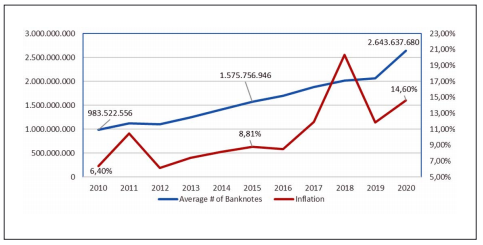
Interestingly, although there is a high level of digitalisation in Turkey, cash in circulation is still increasing. The main cause is the high number of unbanked people compared to developed countries, along with a high inflation rate. In 2020, the number of banknotes in circulation increased by 28% compared with a ten-year average increase of 10%.
Digitalisation has not decreased the amount of cash used in Turkey. Despite that, the cost of cash will remain a solid challenge for banks in 2021. Consequently, cash process automation and efficiency tools, such as prediction/optimisation software using big data and artificial intelligence algorithms, will be on the agenda of the banks.
Another trend for cash logistics will be the pooling of ATMs. State owned banks have announced that they will combine their ATMs into white label ones, which will serve their customers without any additional charges. This is the first wide ranging project in which banks pool their resources to optimise the cost and benefits to be gained from economies of scale. If the project is successful, private banks may want to go for the same kind of projects.
Digitalisation
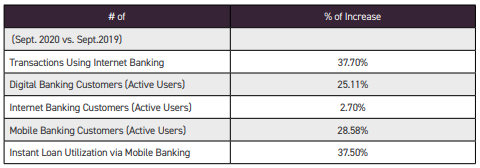
The pace of digitalisation during 2020 increased more than the average because of the pandemic. According to the Deloitte’s 2020 Digital Banking Maturity Report (covering 318 banks from 39 countries), banks have implemented new digital features, or enhanced their digital capabilities, to overcome the effects of the restrictions of COVID-19.
The report analyses digital retail banking in terms of digital functionalities, customer needs research and the user experience. Turkey was considered as one of the digital champions according to this report. For the Turkish banking sector, comparing the September 2020 data with the previous year, the shift to digital channels is clearly visible.
Despite this rate of increase, the number of customers who don’t regularly use digital channels remains high.
In January 2021, the central bank started to pilot the ‘FAST’ project, which enables customers to send money instantly between banks 24/7. During 2020, banks started to provide a service called the ‘Easy Addressing System’ (KOLAS) which enables customers to transfer money between banks by using citizen ID, phones number or e-mail address instead of using IBAN. Together with the developments in open banking applications in the banking sector, FAST and KOLAS will also support the pace of digitalisation in Turkey.
It is reasonable to assume, therefore, that the digital banking transformation will remain as one of the key trends in Turkey in 2021.
Blockchain, cryptocurrency, payment systems
There is no doubt that blockchain services will be a top R&D issue for the banking sector in Turkey. Although banks are still reluctant to use cryptocurrencies, they are heavily investing in providing services via blockchain technology, such as loan application and utilisation, trade finance transactions, digital customer acquisition etc.
As for using cryptocurrencies, the approach of the central bank is very important. At the end of 2020, the Central Bank of Turkey announced that it has formed a department to make R&D studies for cryptocurrencies. It is said that proof of concept studies were successful, and it intends to run a pilot project in 2021. This project may well fast-track a CBDC issue in Turkey.
Subscriber content
Read the full article
Full access to Cash & Payment News articles, newsletters and archives.