
Country Profile: Rwanda

Rwanda is a relatively small land-locked African country in the Great Rift Valley bordering Uganda, Tanzania, Burundi and the Democratic Republic of the Congo. It is the most densely populated mainland African country with a young, mainly rural population numbering 12.6 million.
The 1994 genocide in Rwanda, which saw the death of an estimated 800,000 people, severely damaged the society and its developing economy. Since 2000 the President has been Paul Kagame and the country has placed great importance on overcoming the past and building a stable future based on education and sound development. Its economy, tourist numbers and Human Development Index have grown rapidly since then, and it is one of only three countries in the world to have more women members of parliament than men (Bolivia and Cuba are the other two).
Unusually for a country that was not a British colony, Rwanda is a member of the Commonwealth. It is scheduled to host the next Commonwealth Heads of Government Meeting (CHOGM).
Economy
Subsistence farming is the key economic activity, with tea and coffee exports being] the major foreign currency earners. Despite having no natural resources, nearly 15% of the economy is industrial.
The service sector has grown strongly in recent years, and now accounts for 43.6% of the country's GDP. Moreover, tourism has become increasingly important based on Rwanda’s reputation for being very safe, and the lure of being only one of two countries where mountain gorillas can be seen.
Currency
The currency is issued by the National Bank of Rwanda (NBR) and denominated in Rwandan francs (FRW). Current coin and banknote denominations are: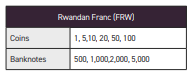
Rwanda issued its first banknote series in 1964, two years after independence from Belgium (when it also separated from Burundi to become a sovereign state). Its notes are produced by Giesecke+Devrient, whose history with the NBR dates back to 1982 with the introduction of the Zebra 100 franc note, continued with the first series after the 1994 genocide and lasts until today.
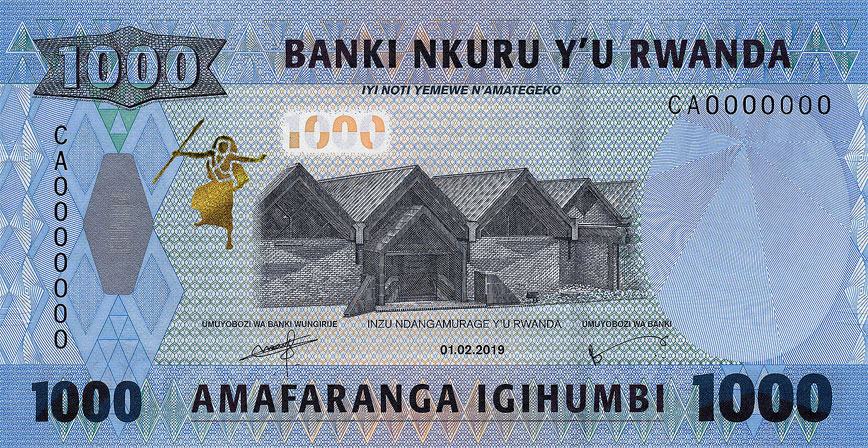
The design of the current series dates back to 2004, but the FRW 1,000, 2,000 and 5,000 have been upgraded frequently since then. The latest design changes took place on in February 2019 when new versions of the FRW 500 and 1,000 notes were issued.
Cash management
The NBR has recently invested in an automated cash centre, the first and most advanced of its kind in Africa, with the objective of increasing the security of the cash in its vault by automating order fulfilment, guaranteeing the traceability of the cash movements and optimising these, both inside the Bank and between the headquarters and the Bank’s five branches.
The contract for the automation of the cash centre, involving an automated vault management system made up of sorting, packing and destruction systems and cash management software, was awarded to Giesecke+Devrient. It is equipped with two of G+D’s high speed BPS® M7 note sorters fitted with NotaPack® systems (with the bundles of processed notes packed in tamper-proof shrinkwrap film), along with G+D’s NotaTracc® platform that combines high speed processing with intelligent automation in the form of automated note handling and logistics, and G+D’s banknote destruction system (BDS®).
NBR also installed G+D’s Compass VMS® and Compass Logistic® software which manages the fully automated vault. Boxes are stacked on top of each other in the vault and a moving robot on an aluminium grid store retrieves them. The movement of the boxes is managed by the software which is aware of all locations and the content of each cash box and manages the robot’s movements accordingly.
The cash centre is integrated with NBR’s Core Banking System T24 and Rwanda’s Integrated Processing Payment System. Commercial banks can send a currency deposit notification or a currency retrieval request to the Bank through a secured web portal. All information is captured, from the commercial bank delivery vehicle details to the number of banknotes per denomination requested by the banks.
The new cash centre gives NBR real-time inventory management and full cash traceability in the cash cycle, triples its storage capacity and increases cash security and deposit and issuance efficiency.
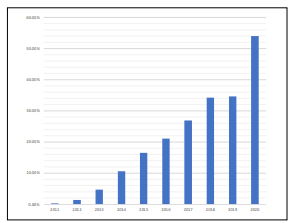 Electronic payments to GDP – 2011-2020.
 Between 2019 and 2020 total deposits at the cash centre fell by 4.81% to FRW 375.07 billion and withdrawals fell 11.47% to FRW 422.12 billion. These reductions were attributed to the impact of the COVID pandemic. The NBR operates an electronic data warehouse with access to data on 31 features.
Use of payment instruments
The NBR annual report to June 2020 contains detailed information about payments in Rwanda.
Rwanda has seen the value of electronic payments to GDP increase every year since these were first measured in 2011, with a surge in 2020 driven by the pandemic and supportive action by the NBR. If ATM withdrawals are a proxy for cash usage, then cash usage fell back as well during the year.
The number of point-of-sale (POS) transactions 2019-20 increased by 29% to 3.9 billion, while the number of ATM withdrawals fell 15% to 331 million.
Mobile users increased 31% to 15 million subscribers and mobile operator agents increased by 9% to 111,422. The increase in the number and value of mobile payment service transactions increased significantly more, 51% (to 504 million) and 87% (FRW 3.84 billion) respectively.
Registered internet banking users increased 13% to 89,035 but mobile banking users fell 6% to 1.8 million. This fall has been attributed to deactivation of inactive users. The number and value of internet banking transactions rose 33% to 1.45 million and by 25% to FRW 2.5 billion respectively.
Mobile banking value rose 131% to FRW 146 billion because of the move to digital payments.
NBR carried out its regular Finscope survey to understand the use of the financial system by the population.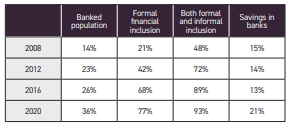
NBR is working to increase the use of digital payments and has introduced four initiatives to achieve this:
Increasing interoperability switch project to allow bank-to-bank, bank-to-wallet and wallet-to-wallet transfers.
New regulations on consumer protection of digital payments.
Awareness campaign of the benefits of digital payments.
Requirement for banks and multi-national organisations to remove charges on some digital payments, eg. mobile transfers and contactless payments.
Final thought
Rwanda has established a reputation for being well organised and having a clear plan for the future based on a well-educated population and the adoption of a modern data led, digital economy.
These themes are evident in this profile from the careful upgrading of the banknotes to the ultra-modern vault management system recently installed to the carefully thought-through drive to increase digital payments.
Looking at the latest developments, one can see that the NBR is well on its way to achieving its objective of being a world-class central bank.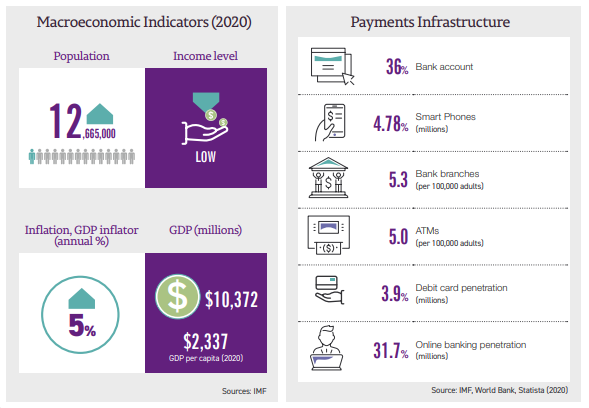
Subscriber content
Read the full article
Full access to Cash & Payment News articles, newsletters and archives.