
Belgium Payments: Are Contactless Payments Leading to a Less Cash Tipping Point?

Leo Van Hove, from Vrije Universiteit Brussel (VUB), spoke at the World Banknote Summit last month about ‘COVID-19 and cash usage in Belgium: have we reached an inflection point?’
His talk was based on data from the annual Digital Payment Barometer survey of a representative sample of 1,181 people 1. He compared the change in results between the pre-COVID early March 2020 and March 2021 surveys.
Before the pandemic, Belgium had the second lowest level of contactless payment usage in Europe, at 16%. The roll out of contactless cards started in the first quarter of 2018 and, by the start of the pandemic, 72% of debit cards and 50% of credit cards were contactless. By the same time in 2021 85% of debit cards and 70% of credit cards were contactless.
Across all age groups, ownership of a contactless card had reached 75% (was 59%), and 69% (was 47%) had paid using contactless means at least once. The ‘awareness’ problem had been severely reduced. At 73%, the 65-74 age group were more comfortable paying contactless than the two youngest age groups.
Unsurprisingly, the number of people who said they had paid contactless in the previous week was up from 27% to 51%, with the 65-74 age group the highest level of usage, 59%. Perhaps fear of COVID was motivating that group. One could also argue that 51% is not as high a figure as one might have expected. The preference for paying with contactless, 36%, was only one point lower than those who preferred to enter a PIN.
Cash payments were down 39%, and in the previous week cash usage had dropped from 72% a year before to 53%. For 16-24 year olds, cash had been used by 23%, down from 34%, and of all the payment options, cash was their last choice. The value of cash held in wallets had fallen slightly from €61.2 to €55.6, while those with no cash increased from 5% to 6%.
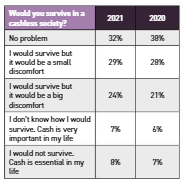
Strangely the number of people who would survive in a cashless society fell from 87% to 85% (top three categories).
Among those with €100 or more in their wallet, those who stated they ‘would not survive in a cashless society’ was up from 12% to 26%, which the presenter described as the ‘hard core’ of cash users. Perhaps consistent with this data, cash was the preferred payment means for 13% of respondents, although it also suggests that for the 87%, they like the idea of cash but in day-to-day life they often choose not to use it.
People experiencing retailers declining cash had increased from 41% to 49%. For most countries pre-pandemic, one could argue that a 41% level of refusal would have been regarded as exceptional, other than in some inner city areas. The survey found that 71% of people then paid electronically, drawing the conclusion that resistance to electronic payment is reducing. One could also argue that it is interesting that people had chosen to pay with cash rather than digital in the first place.
The presenter ended with the thought that the 15% of people who don’t know how they would survive without cash is a significant number, enough to make the future of cash a political issue.
Last word
When one looks at the pandemic data it consistently shows a drop in cash usage, as it does here in Belgium. However, the nuance perhaps points to a different story. Even with the experience of being able to pay electronically, the number of people who think going cashless is not a problem has dropped eight percentage points and the number saying they would not survive has gone up two percentage points. Perhaps the understanding of the value of cash has gone up as well.
1 - The survey is sponsored by sponsored by Bancontact, Payconiq Company, Febelfin, Mastercard, Visa and Worldline.
Subscriber content
Read the full article
Full access to Cash & Payment News articles, newsletters and archives.