
How Ukraine is Managing Cash in a War

The National Bank of Ukraine (NBU) has maintained the supply of cash and cash circulation to over 1,500 bank branches and more than 3,800 ATMs across the country since Russia invaded in February 2022. The Deputy Governor, Oleksii Shaban, has shared their experience.
Cash is managed through the central vault, four cash circulation units of the central bank located in regions of the country and authorised banks In late 2021, the NBU started to decentralise strategic cash stocks in anticipation of disruption.
The war started at the end of February 2022, leading to a sharp increase in demand for cash. The annual growth rate of cash in circulation (CIC) was 19.9% in February 2022, when the invasion started. CIC increased by UAH 51.2 billion in February. To give a sense of scale, in 2020 the peak monthly increase was in May, when it grew by UAH 28.5 billion. In 2021 the peak increase was UAH 31.4 billion in December.
This increased demand lasted through to mid-March when it peaked at 23.7%. It has decreased since then. From May 2022 there has been a slow revival of economic activity in most sectors of the economy.
Shortly after Ukraine was invaded, the NBU fixed the hryvnia’s exchange rate and imposed capital controls. To prevent a run on the banks, the NBU announced it would provide unlimited hryvnia cash and loans to ensure banks could meet withdrawals needs.
Existing risks related to military action have had a significant reduction of cash turnover at banks. War has led to major destruction, the occupation of parts of Ukraine, disruption of supply chains and a growth in cashless payments.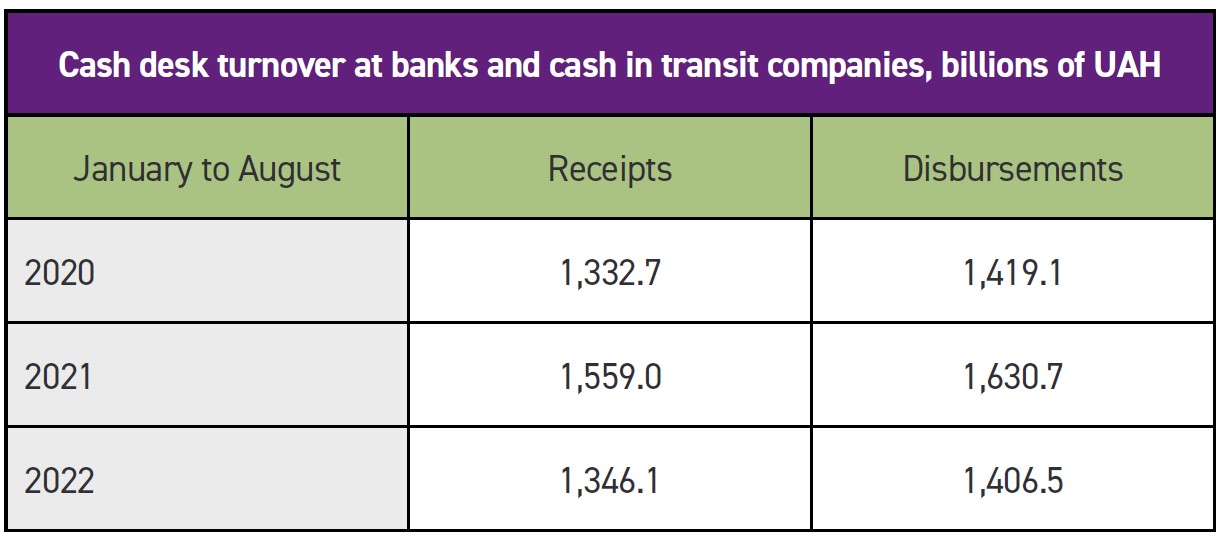
Actions taken to maintain cash circulation
Operations were only performed if there was no direct threat to the life and health of staff and clients of banks
Cash was supplied without limit
Cash handling requirements were relaxed:
No limits on ATM refills
No cap on cash stored in vaults
Purchase with cashback was recommended to merchants
Banks were allowed to receive cash free of charge for pay outs to those serving in the Armed Forces. Banks were required to transfer cashless funds from the bank’s correspondent accounts and state the intended use of the cash.
A daily limit of UAH 100,000 was set for hryvnia cash withdrawals from client accounts in Ukraine.
In order to safeguard cash stocks, some stocks were moved from Kyiv to the western region, daily monitoring of cash stocks at authorised banks was strengthened, stocks in regions with military action were reduced and banks in occupied territories were authorised to make their stocks unfit for issue using mechanical means.
Due to the destruction and disruption of the road network, much of the movement of cash was switched to the rail network. Before the war, Ukraine had over 2,000 armoured cash in transit vehicles. In the first four months of the war, 43% were handed over to the military. In addition, many of the staff at CIT and cash collection units were mobilised.
The cumulative effect has been to make cash collection and transportation harder. As a result, cashless payments have become more important.
Automated cash processing
NBU uses 9 BPS M7s and 13 BPS 1040 sorters, but staff reductions due to mobilisation and air raid warnings have disrupted cash processing. As a result, cash processing volumes have been reduced. One response has been the temporary suspension of fitness and authentication requirements for banks.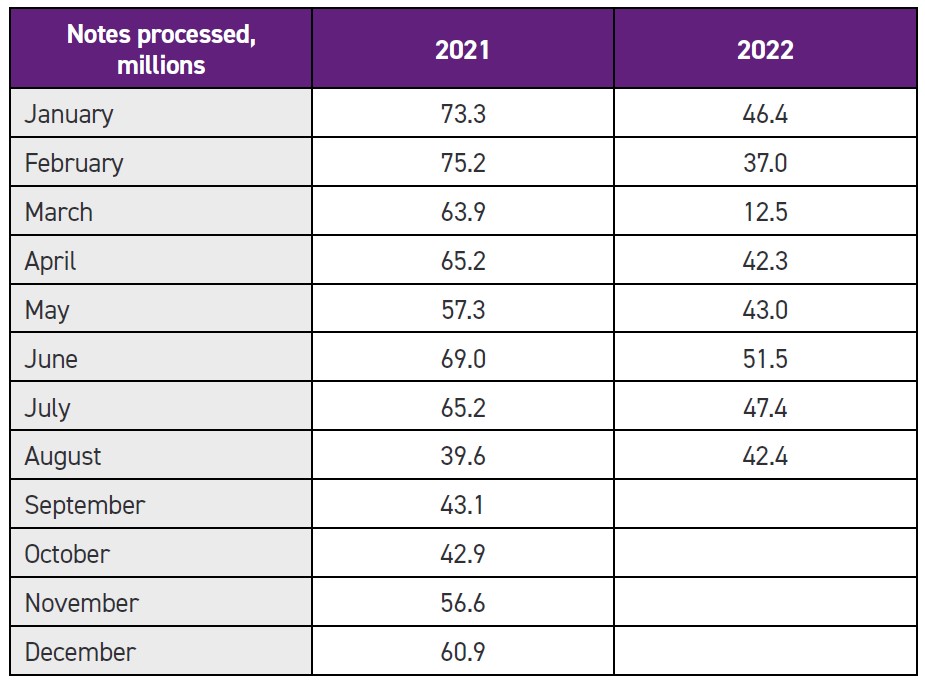
Cash management outside of Ukraine
NBU signed agreements with nine central banks to purchase hryvnia from refugees who had fled to their countries. Between 28 March and 16 September 2022, NBU bought UAH 935 billion from them.
In millions of UAH, this was broken down by Poland (728), Germany (144.8), Netherlands (26.1), Switzerland (12.4), Belgium (9.1), Italy (8.9), Sweden (5), Latvia (0.7) and Malta (0.1).
NBU also entered into agreements with three commercial banks in Austria, Hungary and Moldova. Between 15 April and 7 September UAH 1,245.5 million was purchased.
The impact of the war is starkly shown in this data and report. Cash Essentials has written about how remittances have changed, reflecting the massive refugee flight from Ukraine. Pragmatism, flexibility and ingenuity has been necessary to allow the Ukrainian economy to continue functioning and, hopefully, to start its recovery.
Subscriber content
Read the full article
Full access to Cash & Payment News articles, newsletters and archives.