
Universal Access to Payments Required

The Bank for International Settlements (BIS) has created an open access database of data relating to retail payment for 95 countries from September 2019 to June 2022.
BIS has used this data to write a working paper giving insights into what happened as a result of the pandemic and to learn lessons 1. The data allows an understanding of how retail payment behaviour changed as the waves of COVID cases occurred, as mobility changed and as lockdown measures were introduced.
A key finding was the vital importance of universal access to payments.
Dataset captured
The database consists of five weekly or monthly payment related data sets for 95 countries:
Cash in circulation data
Credit card payment data including the ratio of card not present (CNP) and contactless payments
Work on Central Bank Digital Currencies (CBDC) by central banks
Internet searches on key words such as ‘ATMs near me’, ‘Cash COVID’, ‘CBDCs’ etc.
Use of digital payment apps; their downloads and daily active user data for the top apps.
For 18 countries there were complete data sets during the acute phase of the pandemic between December 2019 and December 2020 and regression analysis was used on these.
Financial and macroeconomic indicators were included.
In terms of the COVID-19 pandemic for each country, COVID severity was assessed using the stringency of the lockdown, Google mobility indices, the number of new cases and the number of total cases relative to the population
Usefulness of the analysis
The data was used to look for common trends and heterogeneity between nations by looking at the pre-pandemic situation, the reaction to containment and changes in payment behaviour. It was possible to assess changes in periods of intensification and the normalisation of the pandemic.
BIS sees the findings as being important for:
Retail and payment strategies
Financial inclusion strategies
Strengthening the mandate for cash
Consideration of retail CBDC issuance.
Findings
During the weeks of the most stringent lockdown there was an increase in CNP (card not present) payments, payment app downloads and the volume of cash in circulation. In countries with higher levels of mobile phone penetration, these changes were less pronounced.
At the end of lockdown and with the return of people’s ability to move around, some of these changes reversed.
Cash. When COVID cases were higher and where lockdown regulations were more stringent, Google search intensity for ‘cash and virus’ increased, reflecting a concern by the public about the transmission of COVID by cash.
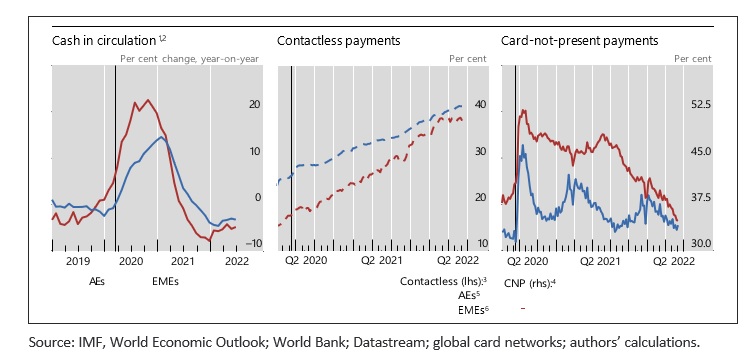
Cash in circulation increased more in Emerging Market Economies (EMEs) than Advanced Economies (AEs) but growth became negative by Q2 2021 for EMEs and by Q3 2021 for AEs.
Searches for ‘ATM near me’ on Google recovered by the end of the study period, reflecting renewed interest in paying with cash.
Contactless payments. Although contactless payments rose, the dispersion from the median across the 95 countries was wide, much wider than for the other payment options.
Contactless payments, which increased rapidly, plateaued in EMEs by Q2 2022.
Card present. Card present transactions dropped 20% for the median country from 75% of transactions to 54% in March 2020 but then recovered nearly all the ground lost. This reflected the lockdowns and loss of mobility at the start of the pandemic.
CNP. CNP rose 18% in the acute phase of the pandemic, but the median level fell back to less than the pre-pandemic level by Q2 2022 for EMEs and close to the pre- pandemic level for AEs by Q3 2022.
App downloads. App downloads and the active use of apps for payment increased, but by the end of 2020 they had peaked. During 2020 downloads and active usage had increased in parallel but from the end of 2020 they diverged. Downloads of the top payment apps started to decline from Q3 2021. The weekly use of the top apps plateaued at the start of 2022.
A key conclusion of the report is that due to the increased familiarity with digital payments and having had the experience of a quick introduction of new payment methods, the move to higher levels of digital payments and lower use of cash is likely to stay.
Lessons learnt
Although the pandemic led to significant changes in behaviour, only some have proven lasting. The changes observed happened almost universally across countries, although the intensity varied.
The challenges faced by those who are not digitally capable have been highlighted in the pandemic, making clear the need for action to close the gap and action to maintain cash. Whether through a CBDC or another means, universal access to payments is important across the world.
1 - BIS Working Papers No 1055. ‘The pandemic, cash and retail payment behaviour: insights from the future of payments database.’ Raphael Auer, Giulio Cornelli, Jon Frost.
Subscriber content
Read the full article
Full access to Cash & Payment News articles, newsletters and archives.