
Denmark Retains a Love of Cash

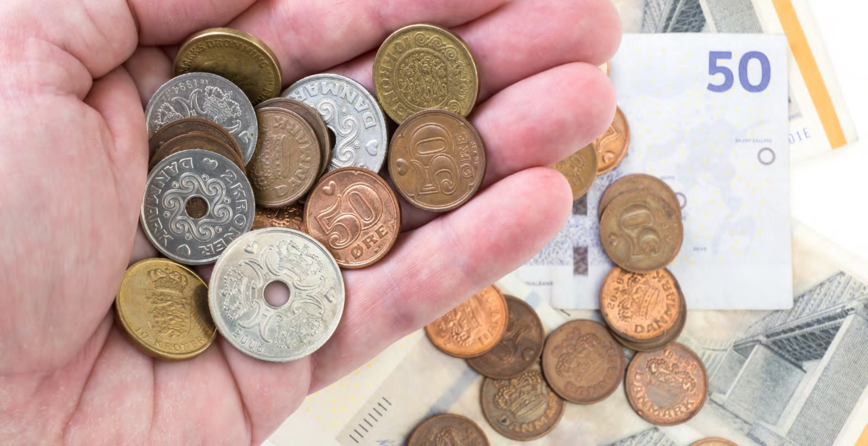
The National Bank of Denmark has issued an analysis paper looking at the use of cash in society 1.
Denmark has one of the lowest levels of cash usage in Europe with only Norway and Sweden with lower levels. Denmark’s value of cash in circulation relative to GDP is 3% compared with the European Union (EU) average of 12%. While the pandemic has reduced cash usage, there are clear signs that Danes still value cash.
This analysis was based on the Bank’s third survey of payment behaviour, which took place 16 August to 17 September 2021. Respondents kept a payment diary for one day and answered a survey. The margin of error was +/-2% for total responses but not by age group, sex etc.
Cash legislation
Denmark has a number of pieces of legislation that both protect and limit the use of cash. The Danish Coinage Act limits the number of coins that can be used to settle a transaction to 25 and the Money Laundering Act prohibits retailers from accepting more than Kr20,000 unless they are subject to the enhanced reporting requirements under the Act.
On the other hand, what is known as the ‘cash rule’ places special obligations on the acceptance of cash in certain payment situations. Shops that have staff and that accept digital payments such as card payments must, between 06.00-22.00, accept cash as well. These hours can be varied if there is a risk of crime to 06.0020.00. This does not apply to remote transactions such as online or self-service and not between businesses due to the risk of money laundering and the costs of cash handling.
These rules might help explain why Denmark uses more cash than Norway and Sweden.
Decline in cash payments
Cash payments in shops as a proportion of the total number of payments have fallen from 23% in 2017 to 12% in 2021. In 2019, 342 million transactions took place, in 2021 257 million, a 25% drop.
The biggest change was in the payment behaviour of the over 70s, reflecting how they have ‘caught up’ with younger people who already used less cash. The number of over 70s using cash in store halved and now only 20% pay with cash. The analysis suggests the ease of contactless and mobile payments accounts for this. In 2017 40% paid in cash.
The pandemic
The survey found that just under 30% of 15-49 year olds rely less on cash as a result of the pandemic, while 37% of 50-79 years olds do.
Cash usage in supermarkets fell from 32% in 2019 to 20% by the end of 2021, although it fell significantly under this at one point in 2020.
Overall demand for cash
While the demand for cash has been falling for some time, 2020 and 2021 saw it increase. The paper considers why and suggests that the fact that people and business could not use cash led to them increasing their holdings. Equally, because there were fewer cash collections and deposits, perhaps more cash was needed because cash wasn’t circulating.
It is interesting to note that banks ran down their cash holdings during the pandemic. The number of cash withdrawals did not increase in the initial stages of the pandemic, so the banks’ need for cash did not change. Despite this, banks reduced their cash holdings from Kr8.8 billion in 2019 to Kr7.1 billion in 2021.
As with other countries, the increase in cash demand was for the higher values. The Kr500 note has increased by 27% since January 2020, while the Kr50 by just 8%.
Person-to-person payments
Nearly a quarter of person-to-person (P2P) payments were in cash in 2021 (23%), compared with 30% in 2019. 70% of P2P payments were made by mobile phones. For the under 30s, 13% of P2P payments were made in cash, down from 27% in 2019. For the over 30s the data shows that paying pocket money was the main driver of their cash use for P2P payments. They said that it was important that cash was not an abstract idea for children.
Half the population had less than Kr100 on them. The 30-39 generation had least cash (they became 18 years old in 2001).
Savings held in cash
Savings in cash were in line with other countries.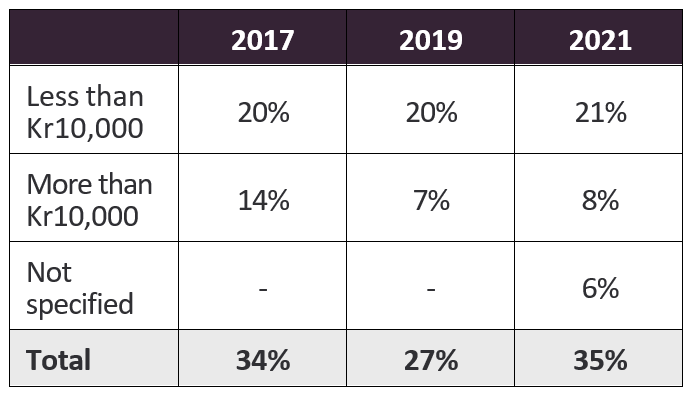
Reasons given for saving were anonymity (12%) and low deposit rates (9%) – Denmark has had negative interest rates since 2019. Emergencies and a means of saving were also given.
Those who liked to pay in cash were more likely to save in cash. 21% of people who pay in cash also save using cash because of negative interest rates, while just 6% of digital only users had similar savings.
Attitude to digital payments and to cash
90% of people were happy with digital payments but, despite that, 40% thought that shops should have to accept cash and 30% thought that a cashless society would cause them problems. People felt cash offered resilience against digital payment failures and that the fact that it is accepted everywhere is important. This contrasts, of course, with 25% of people not having more than Kr100 on them.
Satisfaction with access to and depositing cash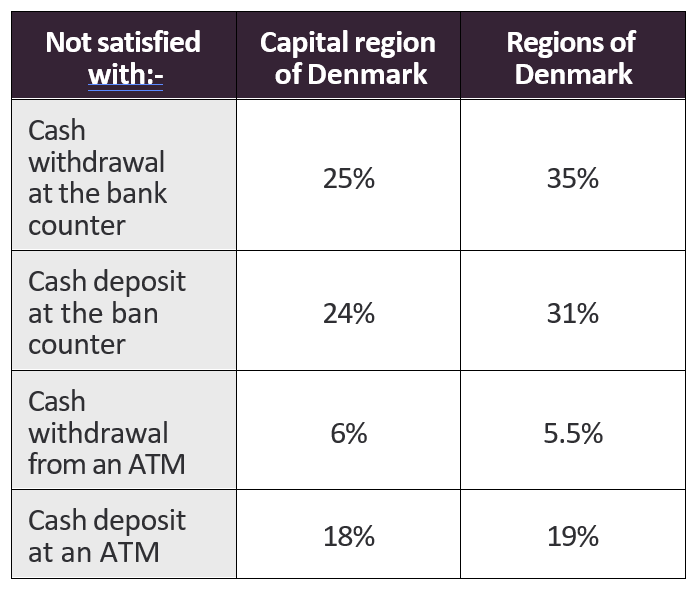
The dissatisfaction may be due to the lack of cash services at bank branches and the charging of fees. 40% of respondents had used cashback in the last year.
The analysis concluded by saying new solutions are needed to increase the satisfaction with cash services.
Final word
This is an excellent and useful report with interesting data and analysis. Given that Denmark is a country with very low levels of cash usage, it is interesting to see that cash retains an important place in people’s priorities and thinking.
The analysis argues against the views of respondents in a number of places, for example that cash is an effective alternative should digital payments fail, and does not ask whether the dissatisfaction with access to and depositing of cash might be contributing to less cash.
The profile of who does not use cash was not investigated (what happened in 2001? Why do the under 30s use more cash than the over 30s?). Presumably the drop in bank cash holdings can be explained by many banks stopping handling cash in their branches.
Perhaps Denmark could consider introducing a cash law about access to cash to go alongside its cash rules on using cash?
1 - ANALYSIS_no3_The use of cash in society.pdf (nationalbanken.dk)
Subscriber content
Read the full article
Full access to Cash & Payment News articles, newsletters and archives.